



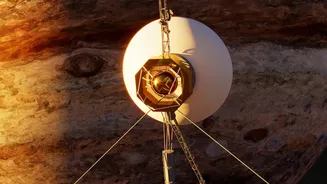


A Mission to a Cosmic Anomaly
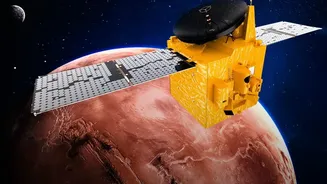
The United Arab Emirates is spearheading an ambitious deep-space journey called the Emirates Mission to the Asteroid Belt (EMA). Scheduled for launch in March 2028, the MBR Explorer spacecraft will embark on a multi-year, five-billion-kilometre voyage.
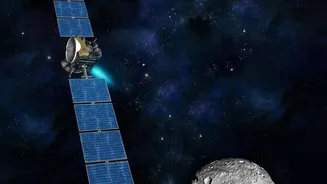
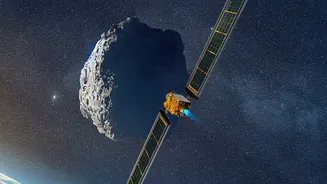
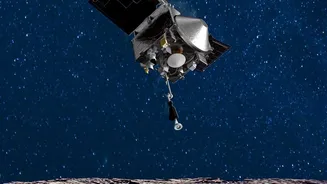
Its primary goal is to study seven different main-belt asteroids, but its grand finale is a rendezvous with 269 Justitia. Discovered in 1887, Justitia has recently become a high-priority scientific target. The mission plan involves the main spacecraft flying past six other asteroids before entering orbit around Justitia in early 2036. Once there, it will deploy a smaller probe, developed in collaboration with key partners, to descend to the asteroid’s surface.
Why is Justitia So Red?
Most asteroids in the main belt, located between Mars and Jupiter, are greyish and composed of rock and metal. Justitia, however, stands out with its distinct, deeply reddish hue. This colour is rare in the inner solar system but is common among Trans-Neptunian Objects (TNOs), icy bodies that orbit the sun beyond Neptune, like Pluto. Scientists believe this reddish colour comes from complex organic compounds called tholins, which form when ultraviolet radiation from the sun cooks surface materials like methane ice. The presence of these compounds on Justitia strongly suggests it did not form in its current location. Instead, it is theorised to be a cosmic migrant, a relic from the frigid outer solar system that was pulled inward during the chaotic early days of planetary formation billions of years ago. Studying Justitia up close could therefore offer an unprecedented look at a building block of the outer solar system without the immense difficulty of travelling to the distant Kuiper Belt.
HEX20’s Crucial Contribution
To land a probe on an asteroid so far from home requires cutting-edge technology and international cooperation. This is where HEX20, a space-tech startup with engineering operations in Thiruvananthapuram, comes in. Selected by the UAE Space Agency and the Technology Innovation Institute (TII), HEX20 was tasked with developing the lander probe's spacecraft bus and its complex software. This marks a significant milestone, as it's the first time an Indian private company has been selected for such a critical role in another nation's deep-space mission. The collaboration brings together the UAE's ambitious vision with HEX20's specialised engineering expertise, alongside partners like Khalifa University, to build the autonomous probe.
The Technology of an Autonomous Lander
The lander developed by HEX20 is a marvel of autonomous technology. After being released by the main MBR Explorer spacecraft, it will have to navigate its final descent to Justitia’s surface entirely on its own. Due to the vast distances, there is no possibility of real-time control from Earth. The probe's software must independently decide when to capture images, what data to prioritise, and how to manage its power. The probe itself isn't designed for a soft landing; it's more of an 'impactor' that engineers hope will survive its contact with the surface. If it does, it will have a brief window of battery life—perhaps 20 to 50 minutes—to capture and transmit the first-ever close-up pictures from Justitia’s alien surface, giving us our most intimate look yet at this red world.