


A Star's Final Chapters
For most of their lives, stars like our Sun are in a stable phase called the 'main sequence', steadily burning hydrogen into helium. But this fuel doesn't last forever. When it runs out, a star enters its post-main-sequence phase, a dramatic and violent
end-of-life transformation. It first swells into a 'red giant,' expanding hundreds of times its original size. After this phase, the star sheds its outer layers, leaving behind a hot, dense core called a 'white dwarf'. This stellar remnant is roughly the size of Earth but contains the mass of a star, slowly cooling over billions of years. Understanding this process is key to predicting the ultimate destiny of countless star systems across the galaxy, including our own.
The Great Engulfment
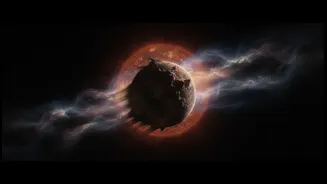
The red giant phase is not a peaceful retirement. As the star expands, it consumes everything in its path. For a system like our own, this means Mercury and Venus will almost certainly be vaporized. For a long time, scientists believed Earth would meet the same fate. This destructive expansion is why finding a planet orbiting close to a stellar remnant is so shocking and rare. Any world that was once in a tight orbit should have been destroyed. The immense heat, chaotic gravitational forces, and the star's expanding atmosphere create a hostile environment that few planets are expected to survive, making every discovery of a 'post-main-sequence planet' a significant event for astronomers.
A Survivor's Tale
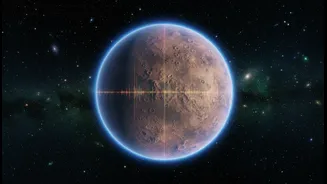
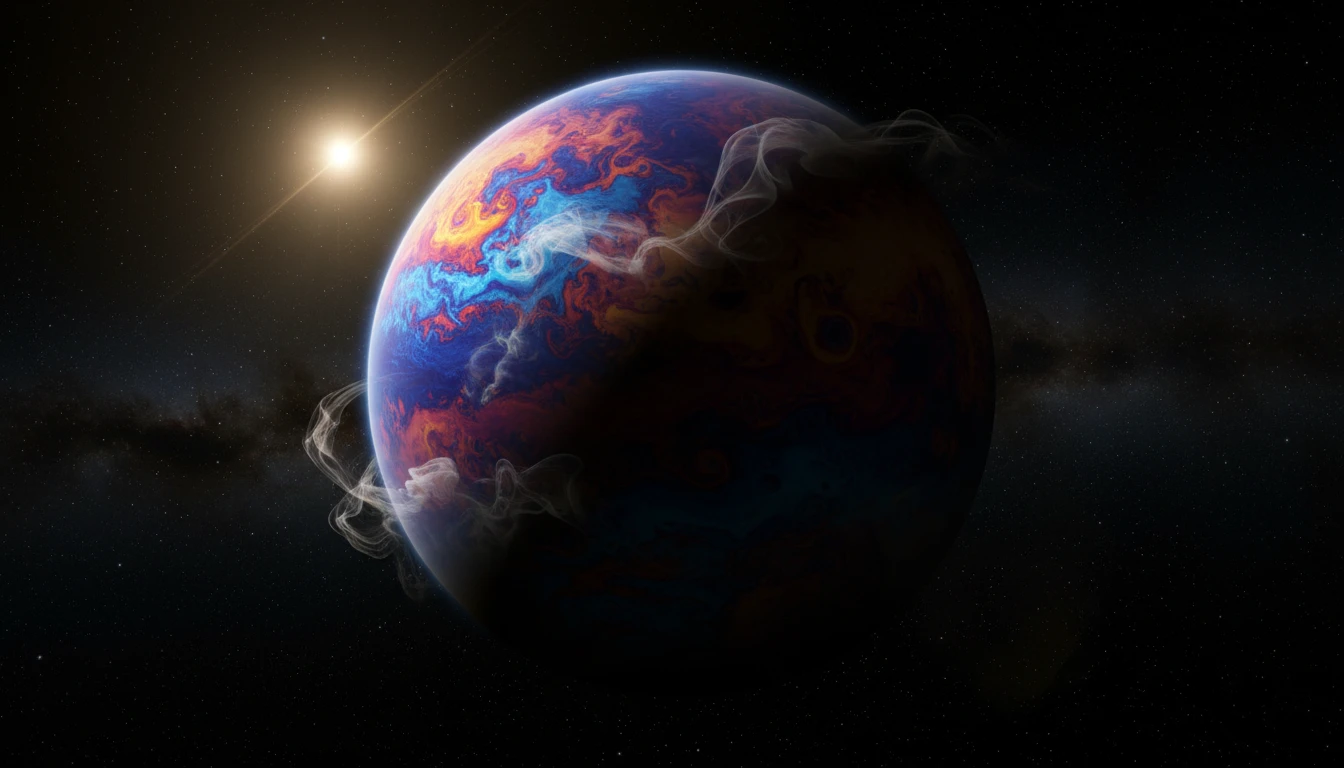
Enter WD 1856 b, a Jupiter-sized gas giant that orbits a white dwarf about 80 light-years from Earth. This system is a true cosmic marvel. The planet is seven times larger than its tiny, dead star and orbits it every 34 hours, a path fifty times closer than Earth's orbit around the Sun. Based on everything we know about red giants, this planet should not exist. It is far too close to have survived the star's expansion in its current location. This celestial puzzle has captivated astronomers since its initial discovery in 2020, and recent analysis has only deepened the mystery while offering tantalizing clues about its improbable past.
Solving an Impossible Orbit
So how did WD 1856 b survive? Recent studies using the James Webb Space Telescope have helped narrow it down to two leading theories. The first is that the planet was originally in a much wider, safer orbit during the star's red giant phase. After the star collapsed into a white dwarf, complex gravitational interactions with two other red dwarf stars in the same system may have 'pushed' the planet inward over billions of years into its current, tight orbit. The second, more dramatic theory suggests the planet may have been partially engulfed by the star's outer atmosphere but somehow survived, eventually settling into a close orbit around the core that remained. The new data, which shows the planet is much warmer than it should be, hints at a turbulent history of being heated and migrating inward.
A Glimpse into Our Own Future
The study of planets like WD 1856 b is more than just cosmic curiosity; it's a preview of our solar system's distant future. In about five billion years, our Sun will also exhaust its fuel and begin its transformation into a red giant. While Earth's ultimate fate remains uncertain, some models predict it might just survive the engulfment by migrating to a wider orbit as the Sun loses mass. It would then circle a cooling white dwarf, a frozen, barren version of the world we know today. Discoveries like WD 1856 b, and a more recently found Earth-sized planet orbiting another white dwarf, provide crucial test cases for these theories. They are laboratories that help scientists refine their models and better understand the long-term evolution of planetary systems.