



Our Modern World's Electric Nightmare
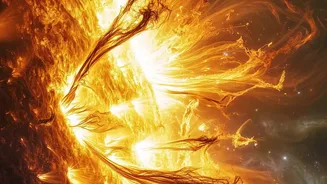
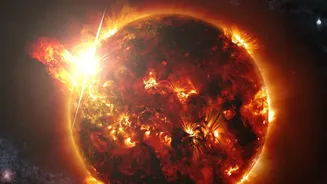
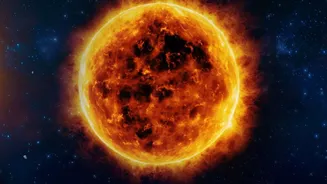
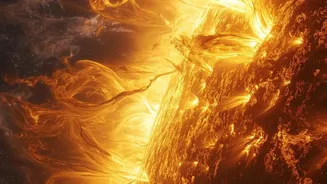
Imagine a world where power grids collapse, GPS signals vanish, and the internet goes dark for weeks or even months. This isn't science fiction; it's the potential reality of a severe solar storm hitting Earth. These storms, caused by massive eruptions
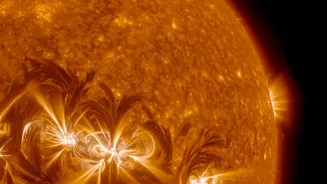
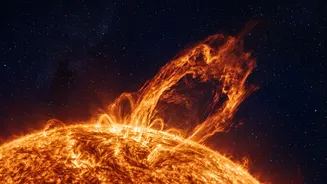
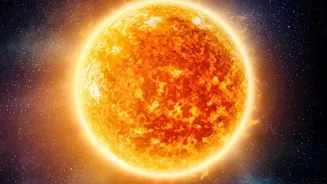
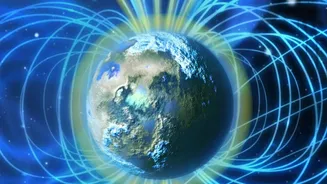
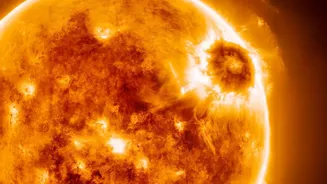
on the sun called coronal mass ejections (CMEs), send waves of charged particles hurtling through space. If Earth is in the path of one of these eruptions, the interaction with our planet's magnetic field can induce powerful electrical currents on the ground. These currents can overload high-voltage transformers, the backbone of our electrical grids, causing widespread and long-lasting blackouts. The last truly massive event, the Carrington Event of 1859, merely caused sparks in telegraph systems. A similar storm today would be catastrophic for a civilization entirely dependent on electricity and digital communication.
Forecasting with a Time Lag
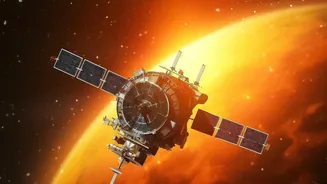
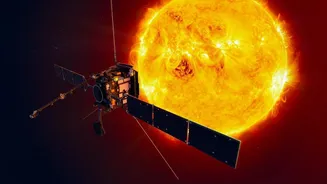
For decades, our best defense has been a network of satellites that act as space-weather buoys, most notably the Deep Space Climate Observatory (DSCOVR), which sits about 1.5 million kilometers from Earth. When a CME passes the satellite, it gives us a warning. The problem? That warning is often just 30 to 60 minutes before the storm impacts Earth. While this is better than nothing, it offers precious little time for power grid operators, satellite controllers, and airlines to take protective measures. It's like hearing a tornado siren only when the funnel cloud is already on your street. Predicting which solar eruption will cause a dangerous geomagnetic storm on Earth has been incredibly challenging, with many unknowns still puzzling scientists.
Enter the AI Forecaster
This is where artificial intelligence comes in. Instead of just waiting for a storm to arrive at a satellite, AI models are being trained to predict the impact of a storm before it even gets there. One leading example is a model called DAGGER (Deep Learning Geomagnetic Perturbation). Developed through a collaboration including NASA, this AI system was trained on vast amounts of data from past solar events and their effects on Earth. By analyzing real-time data on the solar wind—the stream of particles constantly flowing from the sun—DAGGER can predict the specific locations on Earth that will be affected by a geomagnetic disturbance. It sifts through complex patterns in the solar wind that are often invisible to human analysts, providing a much more nuanced and rapid forecast.
A Glimpse into the Future of Prediction
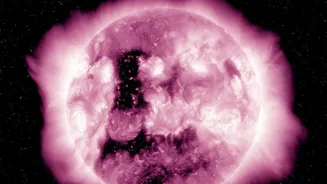
While current models like DAGGER provide a 30-minute warning, the field is advancing rapidly. Researchers are developing other AI systems that aim to provide even earlier alerts. Some models can now predict the emergence of volatile active regions on the sun's surface up to 12 hours before they become visible, giving a heads-up that a storm might be brewing. Other models focus on forecasting the timing and intensity of a storm's arrival with impressive accuracy. This extended lead time is a game-changer. It gives officials the ability to proactively manage power grids, move satellites into safer orbits, and reroute flights away from polar regions where radiation is most intense, turning a potential disaster into a manageable event.
Challenges on the Horizon
Despite the promise, AI forecasting is not a silver bullet just yet. A major challenge is that machine learning models are only as good as the data they are trained on. We have never recorded a modern, Carrington-level event with our current technology, so there is no data from such an extreme storm in the AI's training set. This means the models might struggle to reliably predict the impact of a truly massive, unprecedented event. Furthermore, some of these deep learning models can operate like a "black box," making it difficult for scientists to understand exactly how they arrive at a prediction. Building trust in these systems is crucial, especially when the cost of a wrong decision—like unnecessarily shutting down part of a power grid—is incredibly high.