



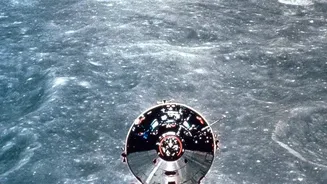

More Than a Test Drive
While the primary goal of Artemis II was to prove the safety and reliability of the Orion spacecraft and its life support systems for future lunar missions, it was far from just an engineering run. The ten-day journey was packed with scientific objectives
designed to leverage the one instrument that hasn't been in lunar orbit for over half a century: the human eye. The four-person crew was tasked with being active scientific observers, bridging the gap between remote satellite imaging and what people can see and interpret in real-time.
Seeing the Moon in a New Light
Scientists were particularly keen to get the crew's perspective on lunar geology. From their unique vantage point, astronauts were able to describe the three-dimensional nature of craters and basins in ways that flat satellite images cannot capture. They were also trained to spot subtle colour variations on the surface, which can indicate the composition of lunar soil, such as volcanic rock rich in titanium or glass formed by ancient impacts. This kind of nuanced observation helps scientists map the Moon's geological history and identify promising sites for future landings under the Artemis programme.
A Surprising Celestial Show
One of the most unexpected findings came from the crew's observations of the lunar surface when it was cloaked in darkness. Scientists on the ground were stunned when the astronauts reported seeing several faint 'pinpricks' of light. After analysis, these were confirmed as impact flashes from small meteoroids, perhaps only the size of a walnut, striking the Moon. While telescopes have detected such impacts from Earth, these were likely the faintest flashes ever witnessed by human eyes, giving researchers new data on the frequency and scale of objects hitting the lunar surface—a critical factor for the safety of future moon bases.
The Human Element in Deep Space
Artemis II was also a crucial mission for human health research. For the entire flight, the crew were subjects in a range of experiments studying the effects of deep space on the human body. Unlike the International Space Station, which is shielded by Earth's magnetic field, the Artemis II crew was exposed to higher levels of cosmic radiation. Wearable sensors tracked their sleep patterns and stress levels, while biological samples were collected to analyse immune system responses. Researchers even used 'organ-on-a-chip' technology, containing cells from the astronauts themselves, to study the impact of radiation on tissues like bone marrow in real-time. This data is invaluable for developing countermeasures to keep astronauts healthy on long-duration missions to the Moon and, eventually, to Mars.