




Cosmic Clouds and Their Cargo
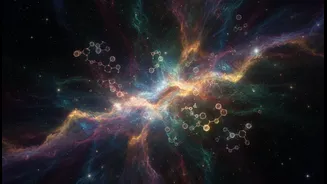
Before a star flickers to life, its raw materials exist as a gigantic, cold, and diffuse cloud of gas and dust. This isn't just empty hydrogen; these clouds are laced with a surprising variety of molecules. Thanks to advanced observatories like the James
Webb Space Telescope (JWST), scientists have been able to peer into these stellar nurseries and identify the chemical building blocks available for new solar systems. These clouds contain simple molecules like water, carbon monoxide, and ammonia, but also more complex organic compounds that freeze onto tiny dust grains, creating icy mantles. Think of these grains as seeds, each carrying a unique chemical starter pack that will eventually be incorporated into asteroids, comets, and planets. The journey from a diffuse cloud to a dense planetary system is one of chemical inheritance and transformation.
The Galaxy’s Chemical Cookbook
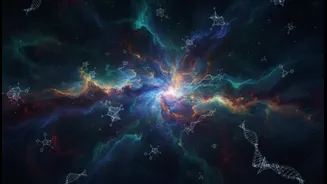
The key ingredients for a habitable planet, at least as we understand it, are liquid water and organic molecules. Observations show that both are commonly available in the planet-forming regions of space. In fact, recent discoveries by the JWST have confirmed the presence of a diverse range of complex organic molecules (COMs) like ethanol (alcohol), acetic acid (the acid in vinegar), and methane in the ices around very young protostars. The presence of these molecules in solid ice form is crucial. It suggests that they are created on the surfaces of cold dust grains and can be efficiently transported into the protoplanetary disk—the spinning platter of material from which planets form. This is far more effective than if they only existed as gas, which can be easily blown away. This icy delivery system ensures that future planets receive a rich inventory of the elements essential for life: carbon, oxygen, nitrogen, and hydrogen.
A Star is Born, A System Inherits
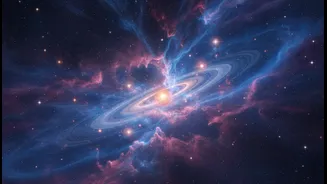
As a portion of an interstellar cloud collapses under its own gravity, it heats up and forms a protostar at its center. The leftover material flattens into a protoplanetary disk. The chemistry of this disk is not identical to the parent cloud; it evolves. Close to the hot, young star, ices evaporate, releasing water vapor and other molecules into the gas phase. Farther out, in the colder regions, these molecules remain frozen onto dust grains. This separation creates distinct chemical zones. Rocky, Earth-like planets tend to form in the hotter, inner part of the disk from dry, rocky grains, while gas and ice giants form in the outer, icier regions. However, the initial chemical budget matters immensely. For example, some disks have been found to be extremely rich in hydrocarbons like benzene but poor in water, which would lead to carbon-rich, water-poor rocky planets.
The Crucial Role of Cosmic Delivery
A rocky planet forming in the inner disk might start out dry, but it isn't doomed to be a desert world. Its chemical makeup can be significantly altered by a process of cosmic delivery. Comets and asteroids, which are essentially leftover icy planetesimals from the outer disk, are rich in water and organic molecules. During the chaotic early history of a solar system, these bodies are frequently flung inward, crashing into young planets. This process is believed to be how Earth received much of its water and a significant portion of its organic material, setting the stage for life to emerge. The study of interstellar comets, like 3I/ATLAS, provides direct evidence of the chemical diversity that exists across the galaxy, with some showing compositions unlike any found in our own solar system, hinting at different formation environments.
The Search for Another Earth
Understanding this connection between interstellar chemistry and planetary composition is a cornerstone in the search for habitable exoplanets. It’s not enough for a planet to be the right size and temperature; it must also have the right chemical ingredients. Recent research suggests there may be a 'chemical Goldilocks zone,' where the balance of elements like phosphorus and nitrogen is just right for life. Too much or too little oxygen during a planet's formation, for instance, can determine whether these crucial nutrients are available on the surface or locked away in the core. By studying the chemical makeup of distant star-forming clouds, astronomers can begin to predict which nascent solar systems have the most promising recipes for creating worlds that are not just planets, but potentially habitable ones.