



First, Let’s Talk About Time
Before we dive into the Venusian twilight zone, let’s quickly reset our definitions of a ‘day’ and a ‘year’. On any planet, a year is straightforward: it’s the time it takes to complete one full orbit around the Sun. For Earth, that’s roughly 365 days.
A day, however, is a bit trickier. We often think of it as sunrise to sunrise (a solar day), but in astronomical terms, it’s the time it takes for a planet to complete one full 360-degree rotation on its axis (a sidereal day). This distinction is the key to unlocking Venus's bizarre secret.
The Slowest Spin in the Solar System
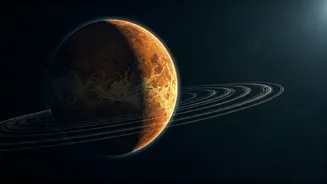
Venus is the celestial equivalent of a slow-motion film. It has the slowest rotation of any planet in our solar system. While Earth completes a brisk spin in 24 hours, Venus takes a staggering 243 Earth days to rotate just once on its axis. This means a single sidereal day on Venus is longer than a spring, summer, and autumn combined on Earth. Scientists are still debating why Venus spins so slowly. Theories range from a massive, ancient impact that nearly halted its rotation to the thick, heavy atmosphere creating a drag that has slowed it down over billions of years.
A Relatively Speedy Year
While its spin is sluggish, Venus’s trip around the Sun is comparatively quick. Being the second planet from the Sun, its orbital path is much shorter than Earth's. It zips around our star in just about 225 Earth days. So, if you were to celebrate your birthday on Venus, you'd be blowing out the candles every 225 Earth days. Now, let’s put these two numbers together. A single spin (sidereal day) takes 243 Earth days. A full orbit (year) takes 225 Earth days. The math is undeniable: a day on Venus is longer than its year.
But What About the Sun?
Here's where it gets even stranger. Remember the difference between a sidereal day (one spin) and a solar day (sunrise to sunrise)? Because Venus rotates backward (more on that in a moment) and so slowly, the time between one sunrise and the next is actually different. A solar day on Venus is about 117 Earth days long. This means that on Venus, you’d experience roughly two ‘sunrises’ in a single Venusian year. Your workday would last for months, and the sun would crawl across the sky at an almost imperceptible pace before finally setting.
Earth's Twisted Sister Planet
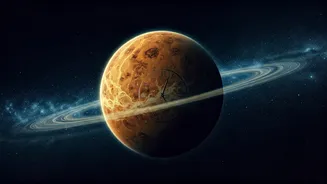
This bizarre timekeeping is just one feature of a planet that has earned the nickname 'Earth's evil twin.' While similar in size and mass to our world, Venus is a vision of a paradise lost. It’s the hottest planet in the solar system, with surface temperatures reaching a scorching 465°C—hot enough to melt lead. Its atmosphere is a toxic soup of carbon dioxide, with clouds of sulfuric acid. The atmospheric pressure at the surface is over 90 times that of Earth, equivalent to being nearly a kilometre deep in the ocean. Any spacecraft that has landed there has been crushed and cooked in a matter of hours.
Spinning the Wrong Way
To add one last layer of weirdness, Venus spins backward. Unlike Earth and most other planets in our solar system, which rotate counter-clockwise, Venus has a 'retrograde' rotation, spinning clockwise. This means that if you could survive on its surface, you would see the Sun rise in the west and set in the east. This backward, lazy spin contributes to its extreme climate and its mind-bending relationship with time. It’s a constant reminder that the rules we take for granted on Earth are not universal.