




A New Light in the Heavens
Across Europe and Asia, stargazers were stunned by the 'new star', or 'stella nova', that burst into view in the constellation Ophiuchus. It remained visible to the naked eye for 18 months, at its peak outshining Jupiter and even being visible during
the day. The timing was fortuitous; many astronomers were already observing that part of the sky due to a predicted conjunction of Jupiter and Saturn, ensuring the event was widely documented. However, it was German astronomer Johannes Kepler whose meticulous year-long observations, detailed in his 1606 book 'De Stella Nova in Pede Serpentarii' (On the New Star in Ophiuchus's Foot), would lend his name to the phenomenon. Today it is known as SN 1604, or Kepler's Supernova.
Shattering Ancient Beliefs
The appearance of SN 1604 was more than a celestial curiosity; it was a direct challenge to the established scientific and religious doctrine of the time. For centuries, the Aristotelian view of the cosmos held that the heavens beyond the Moon were perfect, eternal, and unchanging. Comets and other transient objects were considered atmospheric phenomena. But careful measurements by Kepler, Galileo Galilei, and others showed that the new star exhibited no parallax—the apparent shift in position of an object when viewed from different locations. This proved it was located far beyond the Moon, in the supposedly immutable realm of the fixed stars. Along with Tycho Brahe's supernova observation in 1572, Kepler's Supernova provided concrete evidence that the heavens could, in fact, change, helping to pave the way for the Copernican heliocentric model of the universe.
Unveiling a Cosmic Engine
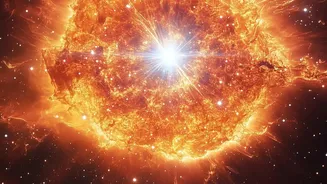
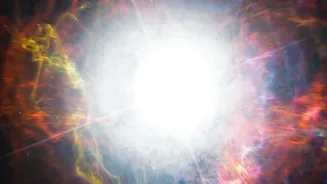
What Kepler and his contemporaries thought was the birth of a star, we now know was its violent death. Modern astronomers have identified SN 1604 as a Type Ia supernova. This specific type of explosion is a crucial tool in modern astronomy. It occurs in a binary star system, typically when a small, dense white dwarf star siphons off so much material from a companion star that it reaches a critical mass and becomes unstable, triggering a runaway thermonuclear explosion. Alternatively, two white dwarfs can merge and explode. Because they all detonate at roughly the same mass, Type Ia supernovae have a remarkably consistent peak brightness.
The Cosmic Yardstick
The uniform brightness of Type Ia supernovae makes them invaluable 'standard candles' for astronomers. Just as you can estimate the distance of a 100-watt bulb by how dim it appears, scientists can calculate the distance to a Type Ia supernova by measuring its apparent brightness from Earth. This technique has become a fundamental method for measuring the vast distances across the cosmos. It was by using these standard candles that astronomers in the late 1990s made a shocking discovery: the expansion of the universe is accelerating. This finding led to the theory of dark energy, a mysterious force believed to be driving this acceleration. The legacy of Kepler's star is directly linked to one of the biggest puzzles in modern physics.
The Remnant's Lingering Secrets
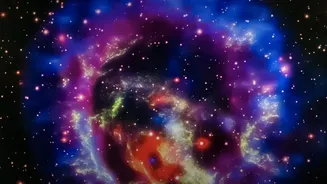
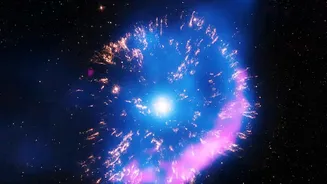
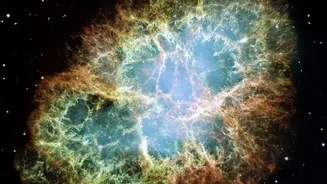
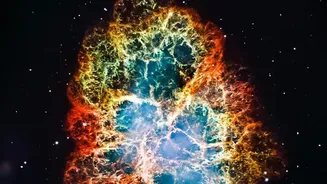
Though the star itself has long since faded, its story is not over. Located about 20,000 light-years from Earth, the expanding cloud of gas and dust left behind by the explosion—the Kepler Supernova Remnant—is a rich field of study. Using modern instruments like the Chandra X-ray Observatory and the Hubble and Spitzer Space Telescopes, scientists can analyze the remnant's composition, temperature, and structure in different wavelengths of light. These observations help refine models of supernova explosions, revealing clues about the exact trigger mechanism of SN 1604 and the environment around the original star system. Recent studies have measured debris from the explosion moving at incredible speeds, some as high as 23 million miles per hour, providing more data on the sheer power of these cosmic events.