


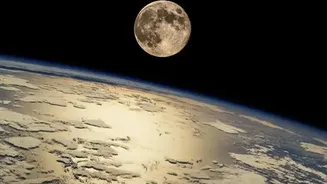
Our Planet, The Alien World
In the grand cosmic search for another Earth, our own planet has become the most important laboratory. To identify potentially habitable exoplanets orbiting distant stars, scientists need to know exactly what to look for. Future powerful telescopes will
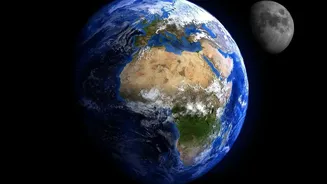
scan the atmospheres of these faraway worlds for 'biosignatures'—telltale chemical fingerprints that hint at the presence of life. The challenge is that these signals are faint and can be ambiguous. This is where looking back at Earth comes in. By observing our own vibrant, living world as if it were a distant exoplanet, scientists can create a definitive catalog of what life looks like from afar. This is the core idea behind concepts like the EarthShine experiment, a project designed to view our home from the Moon to refine the search for life elsewhere.
The Search for Biosignatures
A biosignature is any substance or feature that provides evidence of life. On Earth, life has fundamentally transformed our atmosphere, filling it with gases like oxygen and methane that wouldn't exist in such quantities on their own. These gases are in a state of chemical imbalance that is constantly maintained by biological processes. Without life, they would react with each other and disappear. Observing this disequilibrium is a key strategy for planet hunters. Other signs include the 'red edge,' a sharp increase in reflected light at specific infrared wavelengths caused by vegetation. Detecting these faint signals from a planet light-years away is an immense technical challenge. We must be able to distinguish them from non-biological chemical processes and interpret them correctly. That requires a perfect template: a full-disk, high-fidelity observation of a known inhabited planet.
The Ultimate Vantage Point
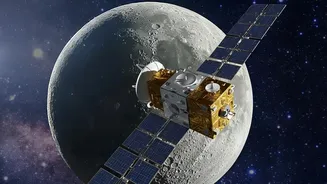
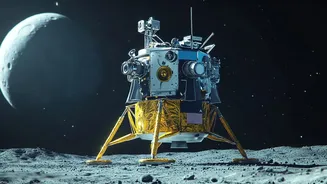
So, why the Moon? The lunar region provides a unique and crucial perspective for this work. An observatory on the Moon or in lunar orbit can see the entire Earth as a single point of light, or a tiny disk, exactly how we see exoplanets. This is a critical simulation that cannot be perfectly replicated from Earth's surface or even from low-Earth orbit. Observing from the ground means looking through our own noisy, shifting atmosphere, which contaminates the very signals scientists want to measure. Being in the lunar region, roughly 384,400 kilometers away, allows for a clean, unobstructed view. It lets instruments capture the integrated light of the entire planet—sunlight that has reflected off oceans, continents, clouds, and passed through the atmosphere. This 'Earthshine,' or light reflected from Earth onto the Moon's dark side, contains the mixed and jumbled signatures of everything happening on our world.
Creating a Blueprint for Discovery
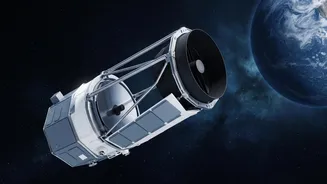
By continuously monitoring Earth from the Moon, experiments can build a detailed blueprint of a living planet's signals. This includes how these signatures change as the planet rotates, revealing different surfaces like oceans and forests, and how they vary with seasons and cloud cover. For instance, studies of Earthshine have already successfully detected the signatures of vegetation and the presence of oxygen. This lunar-based data serves as 'ground truth.' When future missions like the planned Habitable Worlds Observatory (HWO) turn their gaze to a promising exoplanet, scientists will be able to compare the new data to this detailed Earth template. It will help them differentiate a truly Earth-like world from one that just looks similar, improving the chances of making a definitive discovery. The Moon essentially acts as our solar system's greatest scientific mirror, reflecting our own world back at us so we can better see others.