



A 'One-in-a-Million' Discovery
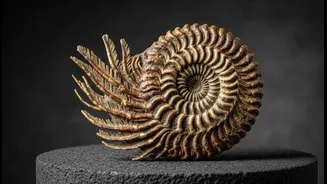
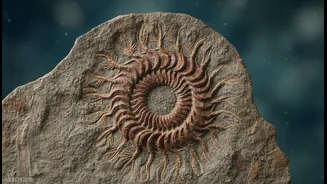
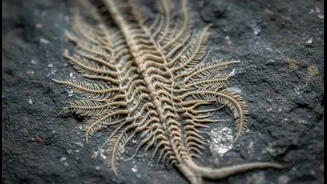
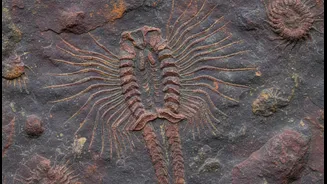
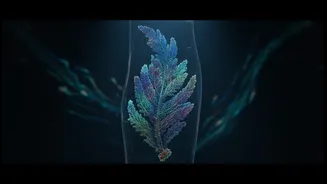
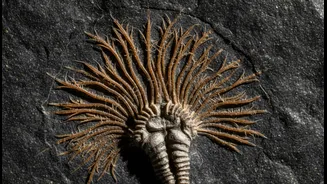
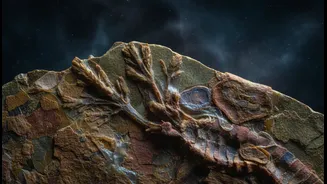
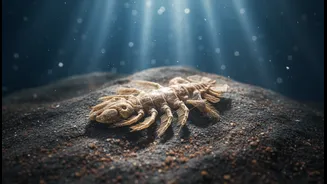
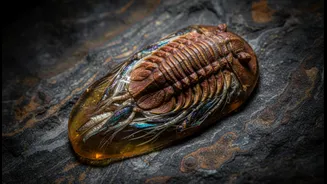
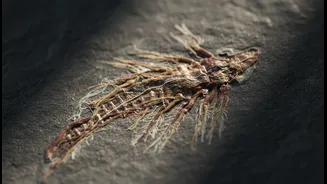
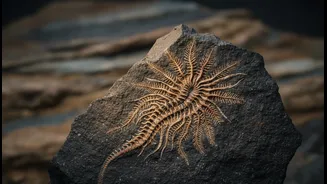
In what researchers are calling a truly 'one-in-a-million' find, a fossil dating back more than 450 million years has been identified with preserved soft tissue. The fossil belongs to a crinoid, an ancient relative of modern starfish and sea urchins that
populated Earth's shallow seas long before dinosaurs. This specific specimen, identified as Dendrocrinus simcoensis, was actually sitting in a small museum in Montréal, its incredible importance unknown until paleontologists from the University of Oklahoma took a closer look. While crinoid fossils are common, they almost always consist of only the hard skeletal plates. This is only the second time soft tissues have ever been documented in a crinoid, and it is by far the oldest example.
Why Soft Tissue Is a Holy Grail
Soft tissues like skin, organs, and in this case, tube feet, are the first parts of an animal to decay after death. Their preservation requires a perfect storm of conditions: rapid burial, low oxygen levels, and the right chemical environment to halt decomposition almost immediately. Think of it as a natural vacuum-sealing process. Because these structures are so rarely seen, their presence provides an unparalleled window into the biology and behaviour of extinct animals. In this crinoid, the preserved tube feet, which the animal used for feeding, offer direct evidence of how it interacted with its environment and captured food from ocean currents in one of Earth's earliest reef ecosystems.
The Scientist's Cautionary Stance
As spectacular as the discovery is, the headline rightly injects a dose of scientific reality. Paleontology is a science of interpretation based on incomplete data. A single specimen, no matter how perfectly preserved, represents just one individual from one specific moment in time and one particular location. Drawing sweeping conclusions about an entire species or ecosystem from one fossil is a significant risk. The history of the field is filled with examples of misinterpretations based on limited evidence, such as the famous Iguanodon thumb spike that was initially placed on its nose like a horn. Scientists must consider whether a feature is typical of the species or an anomaly caused by injury, disease, or the unique fossilization process itself.
The Danger of a Single Data Point
Over-interpreting a single find can lead scientific understanding down the wrong path for years. A fossil might be a juvenile, an unusual variant, or preserved in a way that distorts its features. For example, a fossil snake initially hailed as a 'missing link' because it appeared to have four legs was later re-identified as a type of marine lizard. This is why paleontologists emphasize the need for multiple specimens. Finding similar features across several fossils from different locations builds a much stronger case that the trait is representative of the species. Without that corroboration, even a stunning fossil is just one extraordinary data point, not the final word.
Building a More Complete Past
This crinoid fossil is an invaluable piece of the puzzle of ancient life. It provides a rare, tangible look at the delicate anatomy of an animal that lived 200 million years before the first dinosaurs. It pushes the boundaries of what we thought was possible for fossil preservation and will undoubtedly spark new research into how such processes occur. However, its greatest contribution may be in how it frames the scientific process itself. It is a spectacular find that generates excitement and new questions. The answers to those questions won't come from this single fossil alone, but from the patient, careful work of finding and comparing more specimens, gradually building a more complete and accurate picture of our planet's deep history.