





2001: A Space Odyssey (1968)
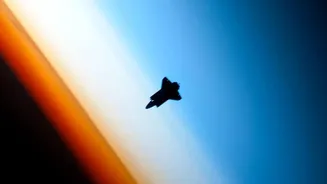
You can't start a list like this without Stanley Kubrick's masterpiece. Decades before digital effects became commonplace, '2001' created a vision of space that still feels terrifyingly real and futuristic. Kubrick’s team pioneered effects like front
projection and slit-scan photography to create the iconic 'Star Gate' sequence and the silent, elegant waltz of spacecraft. The film's commitment to realism, from its rotating sets to simulate gravity to its sterile, functional ship interiors, established a visual language for sci-fi that filmmakers still borrow from today. It used practical effects to achieve a level of visual believability that many modern, CGI-heavy films struggle to match. On a big screen, its deliberate pacing and vast, empty shots of space become an immersive, meditative, and often unsettling experience.
Gravity (2013)
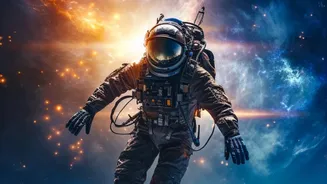
If '2001' is a detached ballet, Alfonso Cuarón’s 'Gravity' is a visceral panic attack in zero-G. The film’s legendary opening is a seamless, long take that establishes the beauty of space before catastrophically ripping it away. Director of Photography Emmanuel Lubezki and the visual effects team at Framestore spent years developing new technology to make the experience feel utterly authentic. They used a custom-built 'light box' with millions of LED bulbs to project images of Earth and space onto the actors, creating realistic lighting and reflections inside their helmets. The result is a film that puts you right inside the suit with Sandra Bullock's character, making you feel every terrifying, weightless tumble. It's a technical marvel designed to be as overwhelming as space itself.
Interstellar (2014)
Christopher Nolan doesn't just make movies; he creates events. For 'Interstellar', he teamed up with theoretical physicist Kip Thorne to visualize concepts that had never been accurately portrayed on screen, like wormholes and a supermassive black hole named Gargantua. The visual effects team wrote new rendering software to simulate gravitational lensing, the phenomenon where gravity bends light. This led to the iconic image of the black hole with a glowing halo, a depiction so scientifically sound that the team published papers on their findings. While some effects, like the Doppler shift, were toned down for aesthetic reasons, the commitment to scientific accuracy was groundbreaking. Seen on an IMAX screen, the journey through the wormhole and the sheer scale of Gargantua are awe-inspiring moments that blend hard science with pure cinematic wonder.
Blade Runner 2049 (2017)
While not strictly a space exploration film, its off-world colonies are central to its plot, and its visual scope is undeniably cosmic. Director Denis Villeneuve and legendary cinematographer Roger Deakins, who finally won an Oscar for his work here, crafted a neo-noir future that is both brutally ugly and hauntingly beautiful. The film is a masterclass in composition, colour, and atmosphere. From the hazy, orange-drenched ruins of Las Vegas to the oppressive, rain-slicked cityscapes, every frame is a painting. Deakins relied heavily on practical lighting and in-camera effects, giving the world a tangible, textured feel that CGI often lacks. The scale is immense, with tiny figures dwarfed by colossal architecture. It’s a film that uses its massive screen to convey not just physical size, but a profound sense of loneliness and existential dread.
Dune (2021)
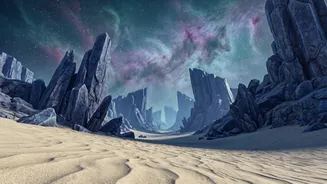
Denis Villeneuve appears again, this time trading dystopian cities for the desert planet of Arrakis. 'Dune' succeeds by making its alien world feel utterly real. The film’s visual power comes from its incredible sense of scale and its tangible, lived-in aesthetic. The ornithopters, with their dragonfly-like wings, feel like functioning pieces of machinery. The vastness of the desert is both beautiful and terrifying, a sea of sand that can swallow armies whole. The sheer size of the sandworms is a moment of pure cinematic awe. Villeneuve and his team focused on location shooting and massive, physically built sets to ground the fantasy. This isn’t just a green-screen spectacle; you can almost feel the grit of the sand and the heat of the suns. On a massive screen, the scale of Arrakis becomes an all-encompassing environment, transporting you to another world.