



A Tale of Two Spoons
The core of the confusion lies in a simple misunderstanding of terms. A 'tablespoon' as a unit of culinary measurement is a standardized volume, while a 'table spoon' is a piece of cutlery used for eating. In most parts of the world, including the US
and UK, a standard measuring tablespoon is defined as exactly 15 millilitres (ml). It’s a precise tool designed for accuracy in recipes. By contrast, the large spoons in your dining set—often called dinner spoons or soup spoons—are not made to a specific volume standard. Their capacity can vary widely, often holding anywhere from 7 ml to 14 ml, which is significantly less than a true 15 ml tablespoon. Some large, ornate serving spoons, also sometimes called tablespoons, can hold even more.
Why Precision Is Crucial in the Kitchen
In cooking, and especially in baking, precision is paramount. Baking is essentially a science experiment where ingredients react with each other in specific ratios. Using a dinner spoon instead of a measuring tablespoon can throw off these ratios with disastrous results. Adding too little baking powder because your spoon was too small might result in a dense, heavy cake that fails to rise properly. Too much salt or spice, measured with an oversized soup spoon, can easily overpower a dish. Inconsistent measurements mean your signature pasta sauce might be perfect one day and disappointingly bland the next. Using proper measuring spoons eliminates guesswork, ensuring your culinary creations are consistent and successful every time.
The Critical Importance for Health and Medicine
The distinction between a measuring spoon and a kitchen spoon becomes even more critical when administering liquid medications. Health authorities like the FDA strongly advise against using kitchen spoons for medicine. Studies have shown that this common practice is a major source of dosing errors, particularly with children. Research published in the Annals of Internal Medicine found that people who used kitchen spoons were prone to significant errors, underdosing by over 8% with smaller spoons and overdosing by an average of nearly 12% with larger ones. For a child taking medicine multiple times a day, these small inaccuracies can accumulate, leading to the treatment being ineffective or, in the worst-case scenario, causing harmful side effects. Always use the dosing syringe, cup, or spoon provided with the medication for safety.
Decoding Your Cutlery Drawer
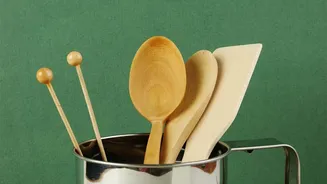
So, what are all those different spoons in your drawer? Generally, a standard flatware set includes a few key players. The teaspoon is the smallest, traditionally used for stirring tea and coffee, and as a measuring unit it equals 5 ml. The dessert spoon is often midway in size, holding about 10 ml. The largest spoon meant for eating is the dinner or soup spoon. Dinner spoons are typically oval, while soup spoons can have a rounder, deeper bowl, but neither is standardized for volume. What some call a 'tablespoon' in a cutlery set is often the largest spoon, intended for serving food from a central dish, not for individual eating or precise measuring. The only way to be certain of a 15 ml measure is to use a spoon specifically marked as '1 Tablespoon' or '15 ml'.
What to Do in a Pinch
If you find yourself without a set of proper measuring spoons, what can you do? For cooking, the most reliable workaround is to use the knowledge that one tablespoon is equal to three teaspoons. If you have a measuring teaspoon, you can use it three times. Lacking that, some people resort to common objects, but this introduces its own inaccuracies and should be avoided for medicine entirely. The best and simplest solution is to invest in a set of measuring spoons. They are inexpensive, readily available, and one of the most essential tools for any kitchen. A standard set typically includes a tablespoon, teaspoon, half-teaspoon, and quarter-teaspoon, giving you the accuracy needed for any recipe.