



A Journey Across the Void
It’s a concept so immense it almost defies imagination. The light from the stars you see tonight didn't just appear. It embarked on an epic journey across the vacuum of space centuries or even millennia ago. This is because light, while the fastest thing
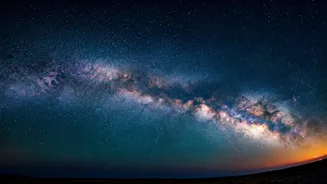
in the universe, still takes time to travel. Scientists measure these cosmic distances in light-years: the distance light travels in one year, which is a staggering 9.5 trillion kilometres. Think about it this way: when you look at a star that is 10 light-years away, you are seeing it as it was 10 years ago. The photons—tiny packets of light energy—that left that star’s surface have been speeding through space, uninterrupted, for an entire decade before finally landing on your retina. The night sky isn’t a static painting; it’s a dynamic, layered collage of different moments in time, all arriving at your eye at once.
Seeing Stars as Time Capsules
This makes every star a tiny time capsule. The brightest star in our night sky, Sirius (or Dog Star), is about 8.6 light-years away. The light you see from it tonight left around the time the first season of *Indian Matchmaking* captured our attention. The light from Polaris, the North Star, began its journey over 430 years ago, around the same time Shakespeare was writing his first plays. Go further: The magnificent constellation of Orion contains stars like Betelgeuse and Rigel. The light from Rigel, a brilliant blue-white supergiant, started its journey to your eye nearly 860 years ago, when the Chola dynasty was a dominant power in Southern India. When you gaze at these celestial bodies, you are literally looking into the past. You are witnessing an event—the emission of light—that happened long before you were born, and in some cases, long before modern civilisation existed. It's a profound connection to history written not in books, but in light.
Finding Perspective in the Immensity
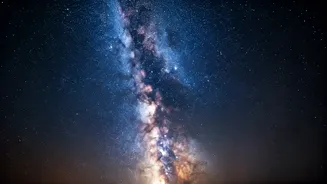
Understanding this cosmic scale can be a powerful antidote to our daily anxieties. The worries that consume our minds—a looming deadline, a difficult conversation, the endless scroll of social media—can feel all-encompassing. But when you stand under a canopy of ancient light, these problems are instantly re-contextualized. Holding the vastness of space and time in your mind has a way of shrinking your worries down to their proper size. This isn't about dismissing your feelings, but about finding a larger container in which to hold them. The universe is not indifferent to you; you are an integral part of it. You are, as the famed astronomer Carl Sagan said, a way for the cosmos to know itself. Realising your smallness in the grand scheme of things isn't humbling in a negative way; it's liberating. It frees you from the pressure of having to have it all figured out.
How to Stargaze Mindfully
You don’t need a fancy telescope or a degree in astrophysics to have this experience. All you need is a clear night and a few moments of quiet attention. Here’s a simple way to practice mindful stargazing: 1. **Find your spot:** Step outside, away from bright lights if possible. A balcony, a terrace, or a quiet park will do. Give your eyes about 15 minutes to fully adjust to the darkness. 2. **Put away distractions:** This is the most important step. Put your phone in your pocket. This moment is for you and the universe. 3. **Breathe:** Take a few slow, deep breaths. Feel the cool night air. Feel your feet on the ground. Arrive in the present moment. 4. **Just look:** Let your gaze wander across the sky. Don't try to name every constellation. Simply notice the different brightnesses, the subtle colours, the sheer number of stars. 5. **Pick one star:** Let your eyes settle on a single point of light. As you look at it, gently remind yourself of its journey. Think about the centuries its light has travelled, crossing an unfathomable emptiness, to meet you right here, right now. Just hold that thought. That is all.