



A Sweet Discovery in Deep Space
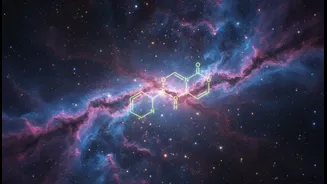
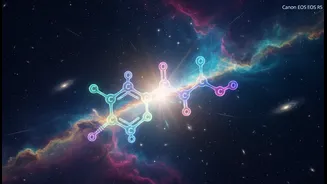
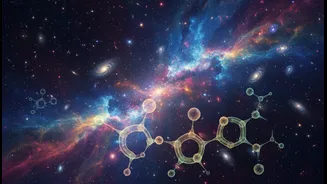
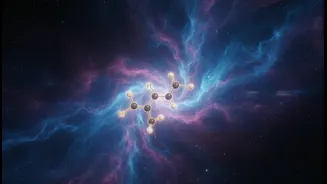
Astronomers have announced the first-ever detection of a true sugar molecule, called erythrulose, in the interstellar medium. Found in a vast cloud of gas and dust near the centre of our Milky Way galaxy, this discovery was made using powerful radio telescopes
in Spain that can identify the unique chemical signatures of molecules from light-years away. On Earth, erythrulose is a four-carbon sugar naturally found in red raspberries and is even used in some self-tanning products. Finding it nearly 27,000 light-years from home, in a stellar nursery where stars and planets are born, suggests that the chemical complexity needed for life can arise even before planets have fully formed.
What Makes a Molecule 'Prebiotic'?
The term 'prebiotic' refers to molecules that are the chemical building blocks of life, but are not life itself. Think of them as the basic ingredients in a recipe. Sugars are essential prebiotic molecules because they perform two critical jobs in biology as we know it: they are a primary source of energy for cells, and they form the structural backbone of DNA and RNA, the molecules that carry genetic information. While erythrulose itself isn't a direct component of our DNA, scientists are excited because in the presence of water, it can transform into other molecules that are considered potential evolutionary precursors to RNA. This discovery strengthens the idea that the universe is dotted with the raw materials needed for life to begin.
From the Stars to Early Earth
One of the biggest questions in science is how life started on Earth. Did all the necessary ingredients form here, or did they get a delivery from space? The discovery of sugars in meteorites and on asteroids has long supported the idea that comets and asteroids may have seeded the young Earth with life's building blocks. The detection of erythrulose floating freely in interstellar space provides a crucial missing link, showing that these vital compounds exist in the very clouds from which solar systems are born. Scientists estimate that during a period known as the Late Heavy Bombardment, around 4 billion years ago, millions of tonnes of sugars like erythrulose could have been delivered to our planet's surface via cosmic impacts, potentially kick-starting the chemical journey towards the first living organisms.
Benefits: A New Chapter in Astrochemistry
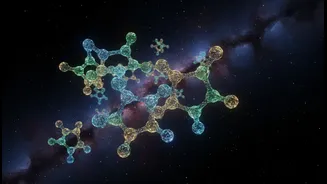
This finding is significant not just for what was found, but for how it changes our understanding of cosmic chemistry. Erythrulose is a relatively complex, 14-atom molecule, making it one of the largest non-cyclic molecules ever found between the stars. Furthermore, it appears to be much more abundant in this region than simpler, three-carbon sugars. This challenges the long-held theory that large molecules in space form slowly, by adding one carbon atom at a time. Instead, the evidence suggests that erythrulose might form more efficiently from the combination of two simpler, two-carbon molecules on the icy surfaces of dust grains. This opens up the possibility that even more complex prebiotic chemistry is happening in these cold, dark clouds than previously imagined.
Limits and the Search Ahead
It is crucial to be clear: this is not a discovery of alien life. It is the discovery of an ingredient, not the finished cake. But it's an incredibly exciting ingredient to find. The presence of erythrulose strongly implies that the universe is capable of producing the chemical precursors to life in abundance. The next step for astronomers will be to use these same techniques to search for other, even more biologically relevant sugars in space, such as ribose—the sugar that forms the backbone of RNA. Finding ribose would be another monumental step in understanding if the recipe for life is a common phenomenon throughout the galaxy. This discovery has provided a new roadmap, telling scientists where and how to look for the next piece of the puzzle.