



What Are Solar Storms?
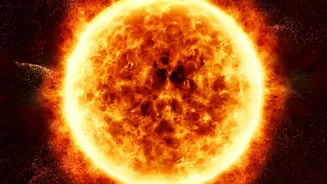
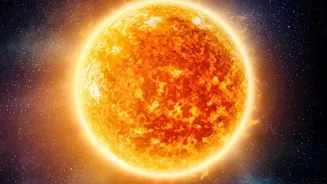
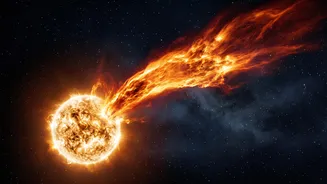
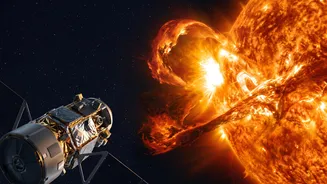
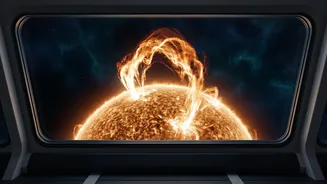
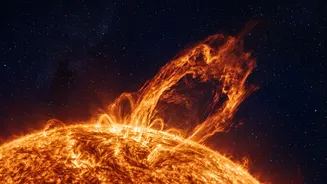
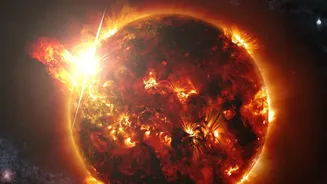
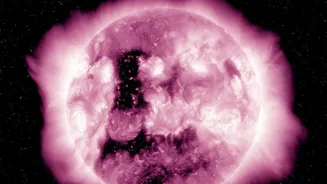
A solar storm is a disturbance on the Sun that can blast enormous clouds of plasma and energetic particles into space. If a powerful event, like a coronal mass ejection (CME), is aimed at Earth, it can interact with our planet's magnetic field. This interaction
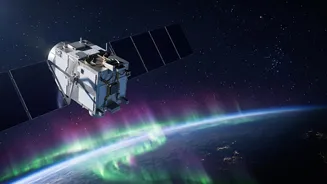
can be beautiful, creating the famous northern and southern lights. But it can also be dangerous, generating geomagnetically induced currents (GICs) on the ground that can overload and damage critical infrastructure. Events like the 1859 Carrington Event, the most intense solar storm ever recorded, caused fires at telegraph stations; a similar event today could have a devastating impact on our tech-reliant society.
The Challenge of Early Warnings
Predicting the impact of a solar storm has always been a monumental challenge. While we can see eruptions on the Sun, knowing exactly where, when, and how severely the resulting geomagnetic disturbance will affect Earth is incredibly complex. Previous models that used AI could only produce forecasts for specific, local areas. Other global prediction models weren't fast enough to be truly useful, often only confirming a storm's impact after it had already begun. For an effective warning system, you need both speed and global accuracy—a combination that proved elusive until now.
Enter DAGGER: NASA's AI Forecaster
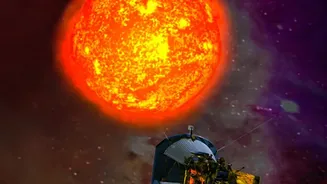
A team of researchers from an international public-private partnership including NASA has developed a groundbreaking solution: DAGGER, which stands for Deep Learning Geomagnetic Perturbation. This AI model was trained using deep learning on vast amounts of data, learning the complex relationships between solar wind measurements from various spacecraft and the resulting geomagnetic disturbances recorded at ground stations across the planet. By recognizing these subtle patterns, DAGGER can forecast the location and intensity of a geomagnetic storm anywhere on Earth with 30 minutes of advance warning. The model generates these worldwide predictions in less than a second and updates them every minute.
How AI Gives Us a Crucial Edge
The 30-minute lead time provided by DAGGER is a game-changer. It's the difference between being reactive and proactive. Previous methods lacked either the speed for a timely warning or the global scope to be universally useful. DAGGER is the first system to combine the rapid analysis of AI with real-time data from space and Earth to produce predictions that are both fast and globally precise. When tested against past solar storms from 2011 and 2015, the model was able to accurately forecast the impacts. This isn't just a theoretical improvement; it's a practical tool that could one day function like a tornado siren for space weather, giving operators time to safeguard vulnerable systems.
Why This Matters for Us on Earth
A severe solar storm could have catastrophic consequences for our interconnected world. It could induce currents powerful enough to damage high-voltage transformers, leading to widespread and long-lasting power outages. These events can disrupt high-frequency radio communications used by air traffic control and the military. Satellites, which are essential for GPS navigation, weather forecasting, and global communications, are particularly vulnerable to damage and orbital decay from solar radiation. A 30-minute warning allows power grid operators to re-route power, satellite controllers to place their assets into a safe mode, and other critical services to brace for impact, potentially preventing trillions of dollars in damage and protecting public safety.