



Cosmic Nurseries and Infant Stars
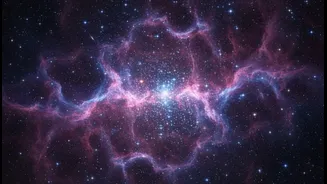
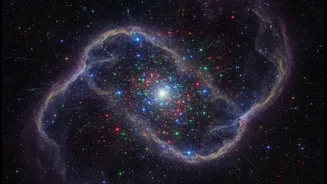
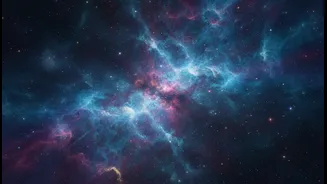
At the heart of our story are young star clusters. Think of them as bustling cosmic nurseries where thousands, or even millions, of stars are born at roughly the same time from the same giant cloud of gas and dust. These clusters, often still shrouded
in the material that birthed them, are called embedded clusters or protoclusters. They are crucial laboratories for understanding stellar evolution because all the stars within them share a common origin. For astronomers, studying these young systems is like having a window into the very first stages of star formation, a process that is otherwise hidden behind thick veils of cosmic dust.
The Universe’s Grand Blueprint
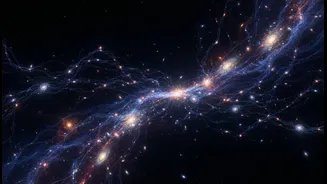
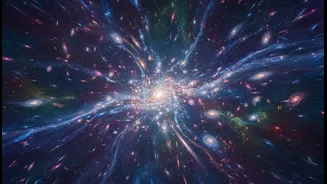
On the largest scales, the universe isn't random; it's organised into a vast, intricate network known as the cosmic web. This web is made of enormous filaments of gas and invisible dark matter, stretching across billions of light-years and connecting massive galaxy clusters at its nodes. Most of the universe's matter, both normal and dark, is found along these filaments. This cosmic scaffolding was established in the very early universe, when tiny fluctuations in density began to grow under the influence of gravity. Over billions of years, these filaments became the channels that funneled matter into the regions where galaxies would eventually form.
Connecting Clusters to the Cosmos
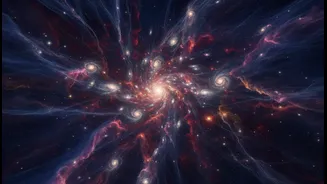
So, how do tiny star clusters reveal this grand design? The answer lies in a process called hierarchical structure formation. The universe builds itself from the bottom up, with small structures forming first and then merging over time to create larger ones. Recent studies show that star formation is not uniform, but is enhanced in the filamentary structures of the cosmic web. New simulations, supported by observations from telescopes like the James Webb Space Telescope (JWST), suggest that some of the earliest and densest star clusters—the potential ancestors of today's ancient globular clusters—may have formed directly within these cosmic gas streams, outside of the main galactic disks. These young clusters act as tracers, showing us exactly where the densest parts of the cosmic web were in the early universe.
Telescopes as Cosmic Time Machines
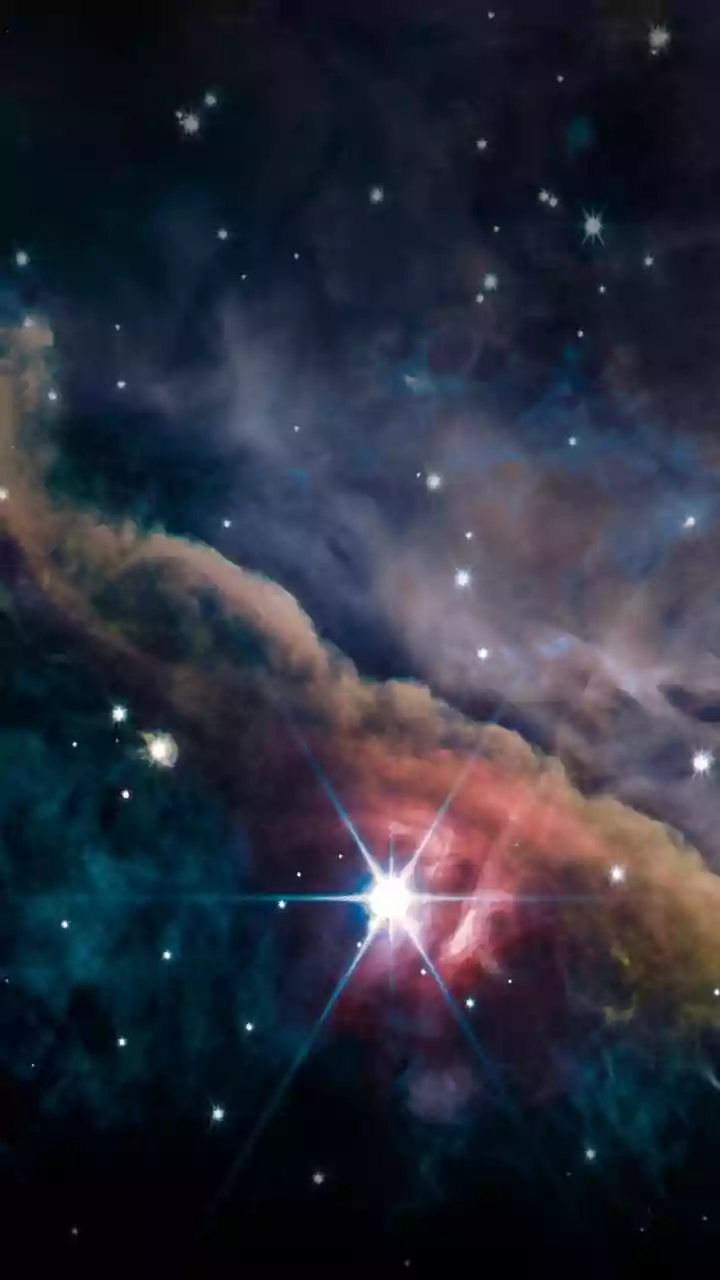
Unlocking these secrets has only been possible with powerful new observatories, especially the James Webb Space Telescope (JWST). Its ability to see in infrared light allows it to peer through the dense dust clouds that obscure young stars from optical telescopes. In a recent study, researchers combined data from JWST and radio telescopes like ALMA to identify dozens of previously hidden young, massive star clusters at the hearts of nearby galaxies. This has allowed them to create a timeline of how these clusters form and evolve, revealing that they are incredibly efficient stellar nurseries. By studying these objects, astronomers are essentially looking back in time, watching the building blocks of galaxies as they first come into being.
From Tiny Seeds to Giant Galaxies
The picture that emerges is one of profound connection. The tiny clumps of gas that collapsed to form the first star clusters did so along the densest pathways of the cosmic web. Over cosmic time, these clusters merge, and the galaxies they inhabit are pulled by gravity along the same filaments, eventually congregating at the intersections to form massive galaxy clusters. Studying a young protocluster, therefore, isn't just about understanding how a few stars form; it's about witnessing an early stage in the birth of a giant galaxy. The immense radiation and stellar winds from these young, massive clusters also have a profound impact, clearing out gas and influencing how and where the next generation of stars and planets can form throughout the galaxy.