


A Sugar Found in the Stars
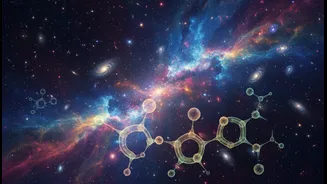
Scientists have announced the first-ever direct detection of a sugar in interstellar space. The molecule, called erythrulose, was found in a vast molecular cloud named G+0.693-0.027, located about 27,000 light-years from Earth near the Milky Way's core.
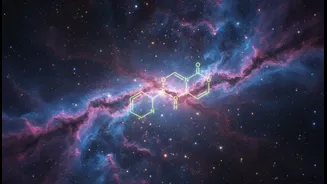
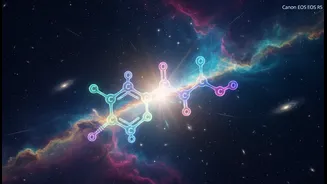
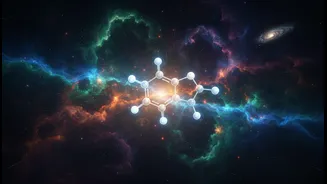
On Earth, erythrulose is a simple four-carbon sugar naturally found in red raspberries and is even used in some cosmetics. Using highly sensitive radio telescopes in Spain, an international team identified the unique radio-frequency fingerprint of erythrulose, matching 12 specific signals from the cloud to laboratory measurements of the sugar. This discovery is significant not just for finding a familiar molecule in a faraway place, but because sugars are fundamental to life as we know it.
The Ingredients for Life, Delivered
The major gain for science is the powerful evidence this discovery lends to the theory of panspermia—the idea that life's essential building blocks were not formed on Earth, but delivered from space. Sugars are crucial biomolecules; they provide energy for metabolic processes and form the structural backbone of RNA and DNA. For years, scientists have struggled to explain how sufficient quantities of these sugars could have formed in the harsh conditions of early Earth. While precursors like glucose and ribose have been found in meteorites and asteroid samples, this is the first time a true sugar has been spotted in the interstellar medium—the raw material from which stars and planets are born. The presence of erythrulose in a pre-stellar cloud suggests these key ingredients are available before planets even form, potentially seeding new worlds with the potential for life.
What Still Needs to Be Checked
Despite the excitement, this is one data point in a very large cosmos, and several things still need verification. First, while the detection is strong, confirming a molecule's presence across such vast distances is exceptionally difficult. Signals from the crowded galactic centre can overlap, and while researchers are confident, further observations by other teams and telescopes will be needed to make the finding ironclad. Second, scientists need to understand its abundance and environment. The initial study found that erythrulose was surprisingly more abundant than simpler three-carbon sugars, which challenges some models of how complex molecules form in space. This suggests that our understanding of interstellar chemistry may be incomplete. Finally, finding a sugar is not the same as finding life. There is a monumental leap from a simple four-carbon sugar to a self-replicating biological system.
The Cosmic To-Do List
The discovery of erythrulose has created a clear and exciting roadmap for astrobiologists. The immediate next step is to search for this sugar in other star-forming regions to see how common it is. More ambitiously, astronomers will now be looking for even more complex sugars, particularly ribose, the five-carbon sugar that is a key component of RNA. The detection of erythrulose proves that it's possible to find such molecules with current technology. At the same time, chemists in the lab will be working to refine their models of how erythrulose could form on the icy surfaces of dust grains in space, as the evidence currently suggests. This interplay between astronomical observation and laboratory experiment is crucial to piecing together the full story of our cosmic origins.