



The Seasoning Obsession
For anyone who uses cast iron or carbon steel, 'seasoning' is a word spoken with reverence. It refers to the layer of polymerised oil baked onto the pan's surface, creating a natural, non-stick coating. A dark, glossy finish is the goal, and a whole community
exists online dedicated to the art of building and maintaining it. When food sticks, it's easy to assume the seasoning has failed. We rush to diagnose the problem, considering another round of oven seasoning or a vigorous scrub. While a damaged or non-existent seasoning layer can cause issues, it's often a red herring for a much more common and immediate cooking error.
The Real Culprit: Heat Management
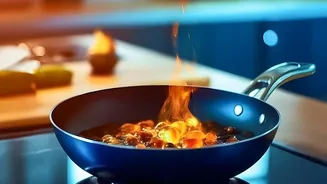
More often than not, the true cause of sticking is improper heat control. Proteins in foods like eggs and meat are chemically programmed to bond with metal. The only way to prevent this is to create a barrier. While seasoning is one part of that barrier, the other, more dynamic part is heat. Dropping food into a pan that is too cold doesn't give the cooking oil a chance to form a protective layer, and the food bonds directly to the metal's pores. Conversely, a screaming-hot pan can cause food to burn and adhere instantly. The sweet spot is in the middle, and finding it is a matter of technique, not just equipment.
The Science of a Perfect Sear
There's a fascinating bit of physics at play called the Leidenfrost effect. When a pan is heated to the correct temperature, a drop of water won't just sizzle away; it will bead up and dance across the surface like a tiny ball bearing. This happens because the hot pan instantly creates a layer of steam that lifts the water droplet, preventing it from making direct contact. The same principle applies to the moisture in your food. When placed in a properly heated, oiled pan, the food essentially levitates on a microscopic cushion of steam, allowing it to glide freely instead of sticking. This allows for the delicious browning of the Maillard reaction without welding your meal to the skillet.
How to Heat Your Pan Perfectly
Mastering heat control is a skill that will transform your cooking. For cast iron and carbon steel, the key is patience. Start by placing your pan on a low to medium heat for 5-10 minutes. This gradual preheating allows the dense metal to heat evenly, preventing hot spots and potential warping. To check if it's ready, use the water test: flick a few drops into the pan. If they sizzle and evaporate, it's not hot enough. If they separate into tiny, frantic beads, it's too hot. You're looking for a single bead of water that glides smoothly. Once you hit that temperature, add your oil. When the oil shimmers, it's time to add your food. Remember that cast iron retains heat exceptionally well, so you may need to use a lower burner setting than you're used to.
When It Is a Seasoning Problem
Of course, sometimes the seasoning really is the issue. How can you tell? A well-seasoned pan will have a smooth, semi-glossy black finish. If you see significant flaking, widespread rust that won't come off, or a dull, patchy, and uneven surface, your seasoning layer is likely compromised. This is especially true if you’ve recently cooked highly acidic foods like tomato sauce or used wine to deglaze, as acids can strip the polymerised oil. In these cases, food may stick regardless of your heat control, and it might be time to give your pan a thorough cleaning and a fresh round of seasoning to restore its non-stick surface.