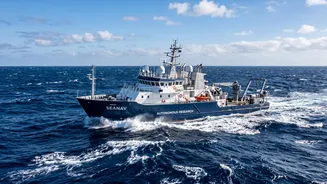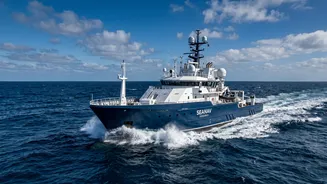




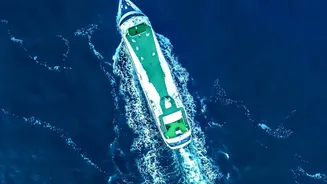
The era of self-driving ships is fast approaching, promising to make global trade cheaper and more efficient. But how do you test a massive autonomous vessel without risking a real-world disaster? IIT Madras has an innovative answer.
The High-Stakes World of Ship Testing
Autonomous ships could
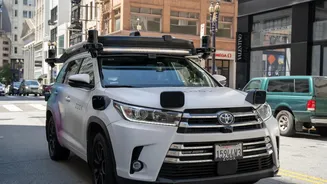
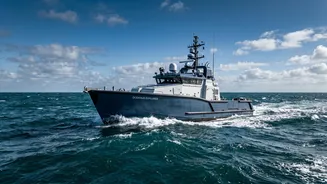
revolutionize the maritime industry, which handles over 80% of global trade. These crewless vessels promise enhanced efficiency and safety by removing human error. However, testing their complex navigation algorithms presents a major dilemma. Real-world trials are incredibly expensive, complex, and carry enormous risks. An accident with a massive tanker or container ship could be catastrophic, far more so than incidents involving driverless cars. This has been a significant barrier to deploying fully autonomous vessels on our oceans, creating a need for a safe, reliable, and cost-effective testing solution.
Introducing SeaNav: A 'Digital Twin' for the Oceans
Researchers at the Department of Ocean Engineering at IIT Madras have developed a groundbreaking platform called 'SeaNav'. It is a real-time digital twin designed to test, validate, and train autonomous maritime navigation systems. Instead of putting a physical ship on the water, SeaNav creates a high-fidelity virtual maritime environment. This digital replica allows developers to simulate everything a ship would encounter at sea — from ocean waves and vessel traffic to changing weather conditions — all within a safe, controlled computer-based world.
How Does a Virtual Ship Navigate?
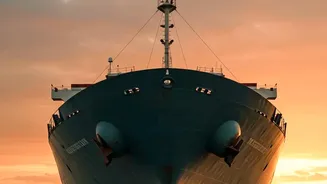
SeaNav is built on the Unity3D engine, a powerful platform used for creating realistic simulations. It creates a digital copy of the maritime world, replicating not just the ship but also its sensors and the ocean itself. The system has been calibrated using a benchmark tanker vessel around 320 meters long, ensuring that the results from the virtual tests closely mirror what would happen in the real world. Unlike simpler simulators, SeaNav also models realistic sensor limitations, such as noise and delays. This means it can test how well a navigation system performs in difficult conditions like fog, heavy rain, or low visibility, which are critical challenges for autonomous operation.
More Than a Simulation, It's an Experience
One of SeaNav's most advanced features is its immersive Virtual Reality (VR) interface. Using headsets, researchers and maritime professionals can step onto the virtual bridge of a ship and experience the simulation firsthand. This allows for incredibly realistic training for scenarios like collision avoidance, approaching a busy port, and complex maneuvering. According to Dr. Suresh Rajendran, an Associate Professor at IIT Madras, the platform combines digital twins, AI, and VR to create an environment where both autonomous systems and human operators can be trained safely and efficiently before they are deployed on actual vessels.
A Boost for India's Maritime Vision
The development of SeaNav is a significant achievement for India's ambitions in the maritime sector. The project aligns perfectly with national initiatives like the 'Sagarmala Programme' and 'Maritime India Vision 2030', which both emphasize the need for smart ports and digital technologies. By providing a platform to develop AI-assisted navigation, SeaNav can enhance safety at major Indian ports like Chennai, Mumbai, and Visakhapatnam by helping to reduce the risk of collisions and groundings. Its multi-vessel simulation capabilities also have potential applications in coastal surveillance, search&-rescue operations, and maritime defence, making it a versatile tool for national security.
The Minds Behind the Innovation
SeaNav is a product of the Department of Ocean Engineering at IIT Madras, a nationally recognized center of excellence in marine technology. This department, part of a larger Centre of Excellence for maritime research, has a history of developing indigenous solutions that save the country significant costs by replacing foreign technology and expertise. The faculty and students at IIT Madras are involved in a wide range of maritime research, from building scaled ship models for testing to developing control algorithms for autonomous vehicles, positioning India as a key player in the future of shipping.