


First, Let’s Define Our Terms
Before we dive into the weirdness of Venus, let’s get our basics straight. When we talk about a ‘day’ and a ‘year’, we’re referring to two different cosmic movements. A year is the time it takes for a planet to complete one full orbit around its star.
For Earth, that’s roughly 365 days. A day, however, refers to the time it takes for a planet to complete one full rotation on its own axis. For Earth, that’s about 24 hours. These two cycles—orbit and rotation—are independent of each other, governed by different forces from a planet's formation and history. On Earth, we are accustomed to having hundreds of days within a single year. This simple, intuitive relationship gets completely turned on its head on Venus.
Venus by the Numbers
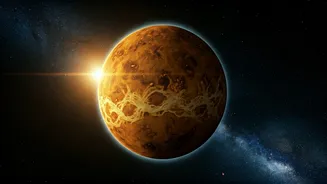
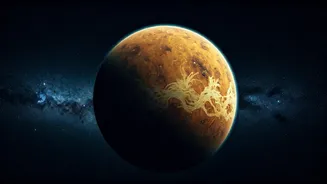
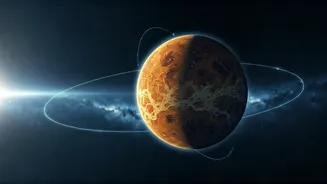
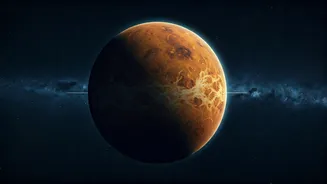
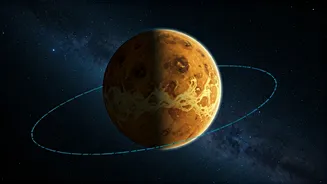
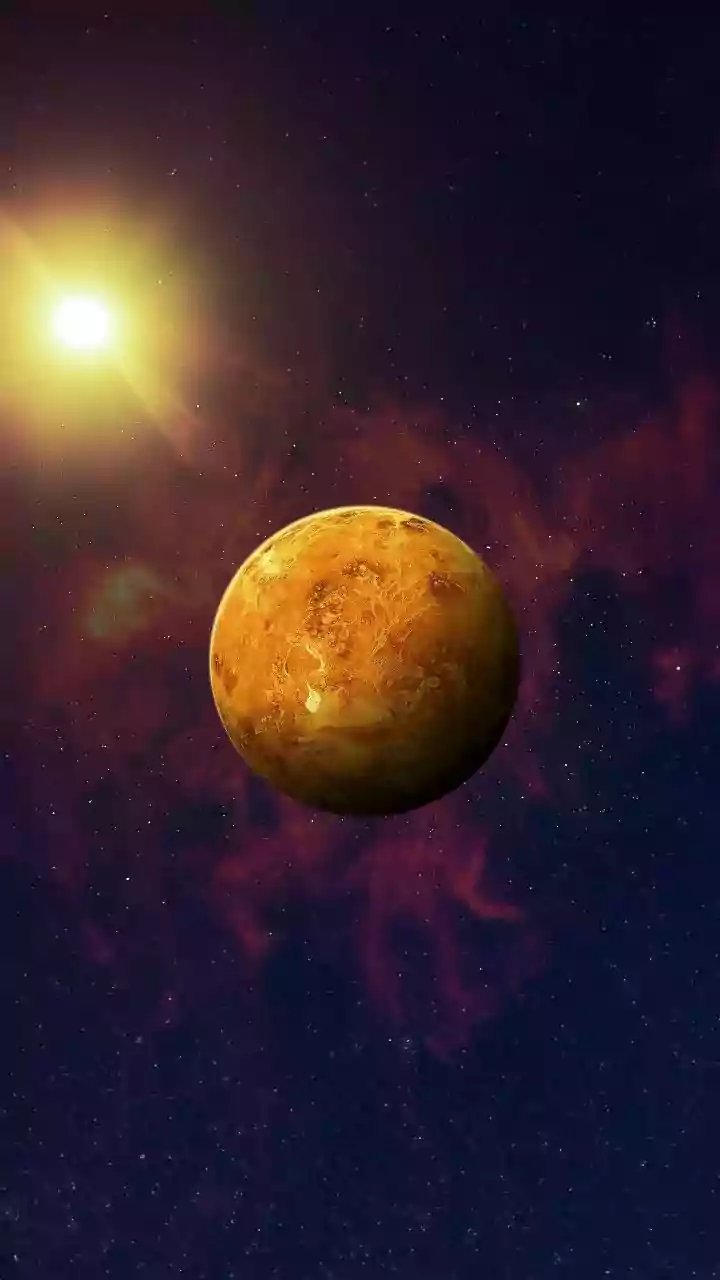
Venus is often called Earth's 'twin sister' because of its similar size and mass, but that’s where the similarities end. Let’s look at the data. A year on Venus—its journey around the Sun—takes approximately 225 Earth days. This is faster than Earth’s orbit, as Venus is closer to the Sun. Now for the mind-bending part. A sidereal day on Venus—one full rotation on its axis—takes an astonishing 243 Earth days. That’s right: the planet takes longer to spin once on its axis than it does to complete an entire trip around the Sun. This makes Venus the slowest-rotating planet in our solar system. To make things even stranger, it spins backwards. On Venus, the Sun rises in the west and sets in the east, a phenomenon known as retrograde rotation.
Why Is Venus So Slow?
So, what put the brakes on Venus? Scientists have a few leading theories, and the most compelling one points to its incredibly thick and heavy atmosphere. Venus’s atmosphere is about 90 times denser than Earth's, composed mostly of carbon dioxide with clouds of sulfuric acid. This crushing atmosphere is in a state of 'super-rotation', whipping around the planet at high speeds. Scientists believe that this dense, fast-moving atmosphere creates powerful tidal forces. Just as the Moon’s gravity creates ocean tides on Earth, the Sun’s gravity creates atmospheric tides on Venus. These powerful tides exert a significant drag on the planet's surface, acting like a giant brake that has slowed its rotation down over billions of years. Another theory suggests that a massive asteroid impact in its distant past could have altered its spin, either slowing it dramatically or even flipping it upside down, leading to its retrograde motion.
A 'Solar Day' on Venus
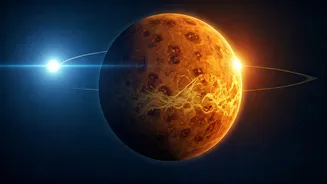
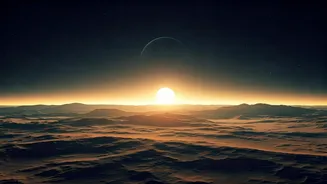
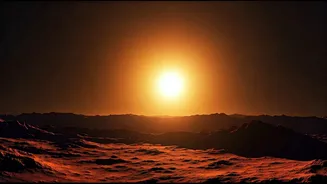
To add another layer of complexity, the time from one sunrise to the next (a 'solar day') on Venus is different from its rotational period. Because the planet is slowly rotating backwards while also orbiting the Sun, the apparent motion of the Sun in its sky is quite unique. The time between two consecutive sunrises on Venus is about 117 Earth days. So, while a single spin takes 243 days, you’d only experience about two sunrises in a Venusian year (which is 225 days long). This means you could watch the Sun rise in the west, go through an entire Venusian year, and the Sun would still be in the sky, slowly making its way towards the eastern horizon for sunset. It’s a concept that challenges our Earth-based understanding of time and the rhythm of day and night.
A World of Extremes
This strange timekeeping is just one of many extremes on Venus. The thick atmosphere that slows its rotation also creates a runaway greenhouse effect, making it the hottest planet in the solar system. Surface temperatures hover around a blistering 465 degrees Celsius—hot enough to melt lead. The atmospheric pressure on the surface is equivalent to being 900 metres deep in Earth’s ocean. It’s a hellish, toxic environment that serves as a stark reminder of how different planetary evolution can be, even for a planet so close in size and location to our own.