





Our Planet's Protective Bubble
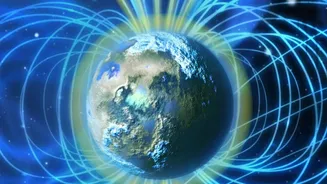
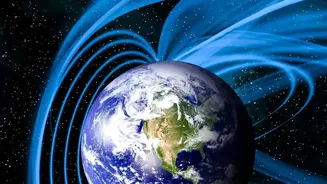
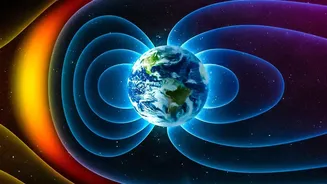
The geomagnetic field is a bit like a giant bar magnet at the center of the Earth, creating a vast bubble around us called the magnetosphere. This field is essential for life. It deflects the majority of charged particles that stream from the sun in the solar
wind. Without it, this constant barrage of radiation would strip away our atmosphere, including the ozone layer, leaving the surface exposed and uninhabitable, much like the planet Mars. For centuries, we have used this field for navigation, but its most critical role is as our planet's silent protector. The existence of this field is a key reason why life was able to flourish on Earth.
A Journey to the Center
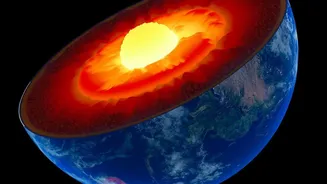
To understand the source of the magnetic field, we have to journey deep inside the Earth. Below the crust and the rocky mantle lies the core, a region composed primarily of an iron-nickel alloy. The core itself has two distinct parts: a liquid outer core and a solid inner core. The inner core is a solid ball about the size of the Moon, despite being hotter than the surface of the sun. The immense pressure at the center of the planet—over 3 million times the pressure at sea level—prevents this superheated metal from melting. Surrounding this solid sphere is the outer core, a vast ocean of churning, electrically conductive molten metal. It is within this liquid layer that the magic happens.
The Engine of Earth's Shield
The engine that powers the magnetic field is a process called the geodynamo. For it to work, it needs a fluid that can conduct electricity (the liquid outer core), the planet's rotation, and a source of energy to keep the fluid moving. That energy comes from the slow, steady growth of the solid inner core. As the entire planet gradually cools, molten iron at the boundary of the inner core 'freezes' or crystallizes, adding to the solid mass. This process is happening very slowly, at a rate of about one millimetre per year. This solidification releases energy in two crucial ways. Firstly, it releases heat, known as latent heat of crystallization. Secondly, and more importantly, as the iron-nickel alloy solidifies, lighter elements like oxygen, silicon, and sulfur are left behind in the liquid outer core.
A Powerful Churning Motion
This release of heat and, particularly, lighter elements creates a powerful churning motion called convection. The leftover liquid, now enriched with these lighter elements, is less dense than the surrounding fluid. Like a hot air balloon, this buoyant material rises. As it moves toward the cooler mantle, it loses heat, becomes denser, and sinks again, creating powerful, large-scale convection currents throughout the liquid outer core. It is this 'compositional convection', driven by the changing chemistry of the core, that is believed to be the primary driver of the geodynamo today. The Earth's spin, through the Coriolis effect, organises these currents into swirling, spiral-like columns.
From Molten Metal to Magnetic Field
The final step is turning this motion into a magnetic field. Because the molten iron in the outer core is an electrical conductor, its movement through an existing weak magnetic field generates powerful electrical currents. In a self-sustaining feedback loop, these massive electrical currents then generate their own, much stronger magnetic field. This is the geodynamo in action: converting the kinetic energy of the moving liquid metal into the magnetic energy that extends far out into space. The slow crystallization of the inner core is therefore the ultimate power source, driving the convection that sustains the entire system.