





The digital world, powered by artificial intelligence, is expanding at a breathtaking pace. But this growth has a voracious appetite. The International Energy Agency (IEA) has issued a stark warning about its hidden cost: soaring energy consumption.
A Doubling of Demand
The
world's data centres are on track to double their electricity consumption by 2030, a surge driven overwhelmingly by the explosion in artificial intelligence. According to the IEA's latest outlook, global data centre power usage is projected to climb from an estimated 415 terawatt-hours (TWh) in 2024 to around 945-1,000 TWh by the end of the decade. That increase alone is more than the entire annual electricity consumption of Great Britain. The IEA forecasts that the AI sector will be responsible for about three-quarters of this dramatic growth. This rapid expansion reverses a long-standing trend where efficiency gains in computing kept overall data centre energy use relatively flat, despite massive growth in services. That era appears to be over, creating a new and urgent challenge for energy grids worldwide.
The AI Chip is the Culprit
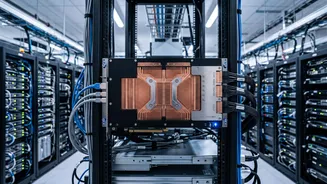
At the heart of this energy dilemma are the high-density computing chips, specifically Graphics Processing Units (GPUs), that power AI. Training and running advanced AI models are far more energy-intensive tasks than traditional computing. For instance, a single query on an AI platform like ChatGPT can consume nearly ten times the electricity of a simple Google search. These specialised chips are packed into servers in ever-denser configurations to handle complex calculations 24/7. While a standard server chip might use 75-200 watts, a high-performance AI GPU can require five to ten times that amount, generating immense heat in the process. This power density, measured in kilowatts per rack, is skyrocketing from an average of 15 kW today toward a potential 60–120 kW for AI workloads, with some predicting peak densities could even approach 1 megawatt per rack by 2030.
The Strain on Global and Local Grids
This tsunami of demand is not just an abstract number; it creates tangible stress on electricity infrastructure. The IEA highlights that data centres tend to cluster geographically, amplifying their impact on local power grids and resources. In India, the data centre market is booming, with installed capacity nearly tripling between 2020 and 2025. Projections show India's data centre electricity consumption could grow nearly fivefold by 2030, accounting for up to 2.6% of national demand. This growth is concentrated in hubs like Mumbai and Chennai, which hold the majority of the nation's capacity. The challenge is compounded by the need for massive amounts of water for cooling—a significant concern in a water-stressed country like India—and reliance on fossil fuels. Globally, the IEA notes a troubling trend: much of this new demand may be met by fossil fuels, with projections showing US data centres relying heavily on natural gas and China's on coal.
The Search for Sustainable Solutions
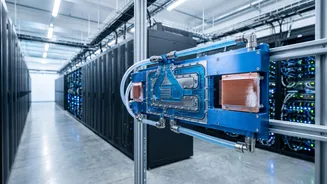
The tech industry is not standing still. Data centre operators have become some of the world's largest corporate buyers of renewable energy. However, the IEA's report suggests that these efforts alone won't be enough to offset the sheer scale of the demand growth, with overall sector emissions projected to rise 70% by 2030. The crisis is spurring innovation in efficiency. A major focus is on cooling, which can account for 40% of a data centre's energy use. Technologies like liquid cooling—either circulating fluid directly to the chip or immersing servers entirely—are becoming essential to manage the heat from dense AI racks. These systems are more efficient than traditional air cooling and can reduce a facility's overall carbon emissions. Other strategies include shifting to more efficient power architectures and using AI itself to optimise energy use within buildings and across power grids.