


The Universe’s Greatest Mystery
First, let's talk about what dark energy is, or rather, what scientists think it is. In the late 1990s, astronomers discovered that the universe isn't just expanding, but that its expansion is speeding up. This was a shock, as gravity should be slowing
things down. To explain this acceleration, scientists proposed the existence of a mysterious, invisible force they named 'dark energy'. It's thought to be an intrinsic property of space itself, a sort of anti-gravity that pushes everything apart. While ordinary matter and its mysterious cousin, dark matter, pull things together, dark energy pushes. And it's winning. It makes up an estimated 68% of the total mass-energy in the universe, yet we have never directly detected it. It remains a placeholder for a phenomenon we can observe but cannot yet explain.
An Instrument for a Cosmic Question
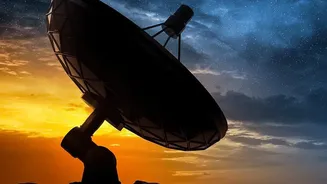
Enter the Canadian Hydrogen Intensity Mapping Experiment, or CHIME. Located in British Columbia, CHIME is a unique radio telescope without any moving parts, looking like a set of four massive snowboarding half-pipes. It was designed specifically to tackle the dark energy problem by mapping the largest possible volume of the universe. Instead of looking at individual stars or galaxies, CHIME does something different: it listens for the faint radio glow of hydrogen, the most common element in the cosmos. By measuring the distribution of this hydrogen gas across vast stretches of space and time, scientists can create a 3D map of the universe's structure and precisely measure how it has expanded throughout its history.
What the New Finding Shows
The latest breakthrough isn't a discovery of what dark energy is, but rather a major technical achievement in how we can study it. For the first time, the CHIME collaboration has proven it can detect the faint signal of hydrogen from when the universe was about half its current age, using only its own data. Previously, CHIME had to cross-reference its observations with data from other optical telescopes—a costly and time-consuming process. This new 'auto-correlation' technique proves that CHIME can work independently, opening up a faster, cheaper, and more comprehensive way to map the universe. It’s like learning to navigate with your own compass instead of having to constantly check someone else's map.
So, What About Dark Energy?
This is where the headline comes in. While proving this new technique is a huge milestone, the initial measurements did not reveal any surprises. The map of the early universe that CHIME produced aligns perfectly with the standard model of cosmology—a model that includes dark energy but doesn't explain its physical nature. In essence, CHIME used a brand new tool to look at the universe and saw exactly what existing theories predicted it would see. The finding provides no new clues to solve the underlying mystery of dark energy. It doesn't support or rule out any of the competing theories, such as whether dark energy is a constant force (the 'cosmological constant') or something that changes over time ('quintessence').
Why This 'Non-Discovery' Matters
In science, a result that confirms the current understanding is just as important as one that shatters it. By independently verifying the expansion history of the universe with a completely new method, scientists have increased their confidence in the standard model. More importantly, this achievement validates CHIME's technique as a powerful new instrument in the search. Now that they know the method works, researchers can analyze the rest of their vast dataset and look even further back in time. This will allow them to create much more detailed maps of the universe's expansion. While this first look didn't reveal the secret of dark energy, it has officially opened a new, powerful window through which scientists can continue the hunt.