







A Lighthouse in the Dark
About 1,000 light-years away, in the constellation Vela, lies the ghost of a star that exploded long ago. At its heart is a super-dense, city-sized object called a pulsar, spinning faster than a helicopter's rotor—about 11 times per second. This rapid
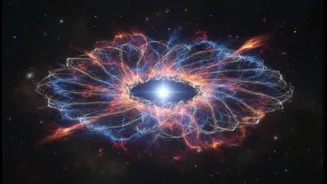
rotation, combined with a powerful magnetic field, causes it to sweep beams of radiation across the cosmos, much like a celestial lighthouse. This specific pulsar, known as the Vela Pulsar, is one of the brightest in our sky and powers a vast cloud of gas and energetic particles called a pulsar wind nebula. For years, this nebula has served as a natural laboratory for studying some of the most extreme physics in the universe.
The Old Picture: An Educated Guess
Until recently, our understanding of what happens inside these violent nebulae was based on powerful but incomplete models. Scientists knew that the pulsar's wind—a torrent of particles flung out at near-light speed—crashes into the surrounding gas, creating shockwaves that accelerate particles and generate X-rays. However, they had to make assumptions about how this energy transfer worked. A key theory was that turbulent, chaotic shocks were responsible for accelerating the particles. Models also predicted what the magnetic fields inside the nebula should look like, but directly measuring them in X-rays was impossible. These models were the best science had, but they were still just sophisticated assumptions built on indirect evidence.
A New Map Made of Polarized Light
Enter NASA's Imaging X-ray Polarimetry Explorer, or IXPE. Launched in late 2021, this space telescope has a unique capability: it can measure the polarization of X-rays. Think of polarization as the direction in which light waves are organized. By measuring it, IXPE can directly map the structure and alignment of magnetic fields, something that was previously out of reach. When IXPE was pointed at the Vela pulsar wind nebula, it created the first-ever X-ray polarization map of the object. This wasn't just another pretty picture of space; it was a direct measurement of the invisible magnetic architecture shaping the nebula.
Challenging Old Assumptions
The IXPE data delivered a major surprise. It revealed that X-rays from the nebula were highly polarized, in some regions reaching over 60%, which is near the theoretical maximum for this type of emission. Highly polarized light means the magnetic fields are incredibly well-ordered, not the chaotic, tangled mess that many theories predicted. This finding suggests that the particles are not being accelerated by turbulent shocks as previously thought. Instead, the energy is likely transferred through a smoother, more organized process. While some aspects, like the overall donut-shaped structure of the field, were in line with expectations, the extreme level of orderliness has sent theorists back to the drawing board to refine their models of particle acceleration.
Why This New Map Matters
This shift from assumption to direct measurement is a pivotal moment for astrophysics. For one, it provides a much clearer picture of how pulsars convert their rotational energy into clouds of high-energy particles, a fundamental process that drives some of the most luminous objects in the cosmos. It also serves as a crucial test for our theories of physics in extreme environments—places with magnetic fields and densities far beyond anything we can replicate on Earth. The findings from Vela, which have been published in the journal Nature, demonstrate the power of X-ray polarimetry as a new tool in the astronomer's toolkit. By using objects like Vela as a laboratory, scientists can probe some of the deepest questions in astrophysics, such as how particles are accelerated to nearly the speed of light.