




What the Latest Numbers Show
In July 2026, Indian Railways reported a substantial 9% year-on-year increase in freight loading, handling 141.3 million tonnes. This growth wasn't isolated; it reflects sustained demand across key economic sectors. The movement of crucial commodities
saw double-digit growth, with iron ore up by over 22%, and both coal and food grains increasing by 11.5%. This surge in traffic directly translated into higher earnings, with freight revenue growing by 8% in the same period. This isn't just a statistical spike but an indicator of robust industrial and agricultural activity, with the railways stepping up to meet the demand, especially by increasing coal supplies to power plants by 20%.
The Challenge of a Congested Network
For decades, India's railway network has been a victim of its own success. Most of the country's high-density routes have been operating at or even above 100% capacity. This congestion is a major bottleneck. When a single network has to accommodate both ever-increasing passenger services and vital freight transport, something has to give. Historically, freight trains have been the ones to suffer, often getting sidelined to prioritize passenger trains. This made rail a less reliable option for time-sensitive cargo, pushing a significant share of freight onto India's already overburdened road network. The share of rail in total freight traffic had fallen dramatically over the decades, from nearly 89% in the 1950s to around 27% in recent years. This inefficiency not only adds to logistics costs for businesses but also has a larger environmental impact.
The Strategic Push for a Modal Shift
The recent increase in freight traffic is part of a deliberate, long-term government strategy to reverse this trend. The goal, outlined in the National Rail Plan (NRP), is to increase the modal share of railways in freight transport from the current 27% to an ambitious 45% by 2030. Shifting freight from road to rail offers significant advantages. Rail is far more fuel-efficient and environmentally friendly for long-haul transport. Achieving this modal shift is crucial for lowering India's logistics costs, which are high compared to global benchmarks, and for meeting its climate goals by reducing carbon emissions. The NRP is a blueprint to create a 'future-ready' railway system that can handle demand proactively rather than reactively.
Dedicated Freight Corridors: The Game Changer
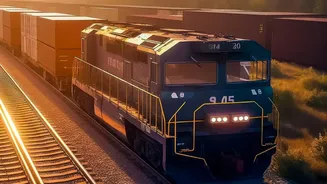
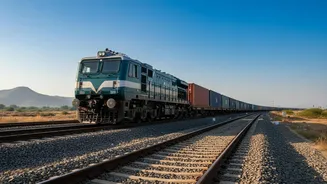
The centrepiece of India's capacity expansion strategy is the Dedicated Freight Corridor (DFC) project. These are high-speed, high-capacity railway lines built exclusively for transporting goods. By separating freight from passenger traffic, DFCs allow goods trains to run at much higher speeds—up to 100 km/h compared to the old average of 25-30 km/h on congested lines. The recently completed Western DFC and the operational Eastern DFC are already having a massive impact. Despite making up a small fraction of the total rail network, the DFCs are handling a disproportionately high share of freight traffic. This has not only decongested existing lines, allowing for more passenger trains, but has also made rail a viable and competitive option for a wider variety of goods, including containerized cargo and finished products.
Building Capacity for the Future
The freight increase and the success of the DFCs are just the beginning. The National Rail Plan envisions a massive infrastructure scale-up, including identifying new DFCs and multi-tracking congested routes. The government is making huge capital investments to expand the network, electrify routes, and upgrade signaling systems. The plan is not just to add more tracks but to build an integrated logistics ecosystem. This includes developing multi-modal logistics parks, improving port connectivity, and leveraging technology for better efficiency. While challenges like land acquisition and securing massive funding remain, the direction is clear. Indian Railways is transitioning from being just a transport provider to becoming a comprehensive logistics solution, aiming to almost double its freight movement to 3,000 million tonnes to meet its ambitious targets.