




The Universe’s Earliest Cities
When you look up at the night sky, you are seeing a snapshot of history. The farther we look, the further back in time we see. Today, the universe is structured like a giant cosmic web, with massive clusters of hundreds or thousands of galaxies forming
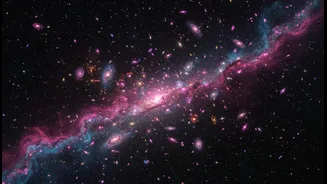
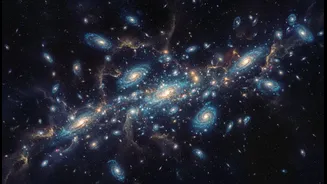
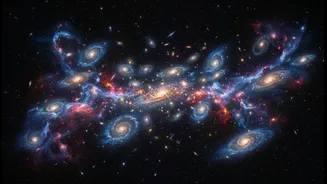
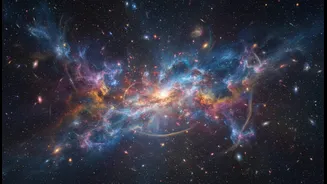
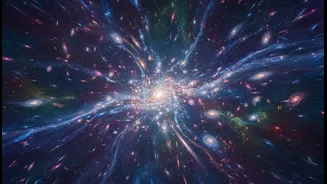
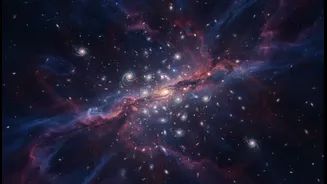
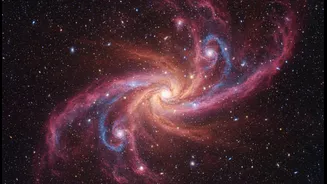
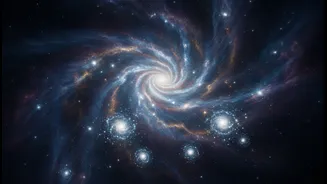
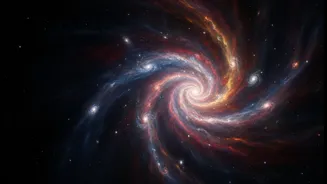
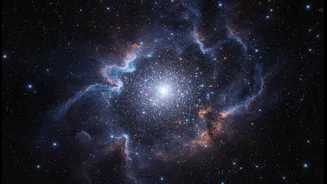
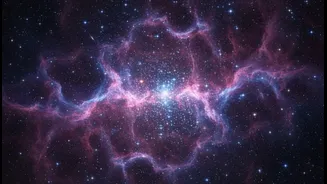
nodes connected by filaments of gas and dark matter. These clusters are the great, gravitationally-bound metropolises of the cosmos. But they didn't appear overnight. To understand their origin, astronomers hunt for their ancestors: 'protoclusters'. A protocluster is not yet a stable, collapsed cluster. Instead, it's a sprawling, messy region in the early universe, billions of light-years away, where an unusual number of young galaxies are starting to gather. Think of it less like a finished city and more like the initial plans and first settlements spread across a wide, promising valley. These are the very beginnings of structure, a 'nebulous entity' of matter destined to one day form the cosmic giants we see closer to home.
Cosmic Detective Work
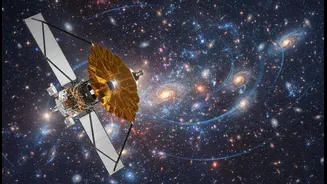
Finding these ancient galactic nurseries is a monumental challenge. Because they are so far away, their light has traveled for over 13 billion years to reach us. As the universe expands, this light gets stretched into longer, infrared wavelengths that are invisible to the human eye. This is where powerhouse observatories like the James Webb Space Telescope (JWST) come in. JWST is specifically designed to detect this faint, ancient infrared light, allowing it to peer into the era when the first galaxies were forming. Astronomers look for regions of space with a higher-than-average density of galaxies. It’s a painstaking process, often requiring multiple observations to confirm that these galaxies are truly companions on a cosmic journey and not just a trick of perspective. Instruments can analyze the light for signatures like Lyman-alpha emission lines, which act like a cosmic barcode to confirm the immense distance and shared location of these protocluster candidates.
Why These Cosmic Toddlers Matter
Studying protoclusters is fundamental to testing our entire understanding of how the universe evolved. They are the primary laboratories for understanding how the largest gravitationally bound structures came to be. Our leading model of cosmology predicts a 'bottom-up' formation, where small structures merge over time to create larger ones. Protoclusters, with their chaotic assemblies of young, star-forming galaxies, provide direct evidence for this hierarchical process. Furthermore, these regions were cosmic engines in the early universe. The galaxies within them were forming stars at rates hundreds of times faster than our Milky Way does today. This intense activity likely played a crucial role in the 'Epoch of Reionization', a key period when the first stars and galaxies produced enough light to burn through the neutral fog that once filled the cosmos, making it transparent.
The Communication Black Hole
If protoclusters are so important, why do they seem so obscure? The simple answer is that they are incredibly difficult to explain. The scales of time and distance are mind-boggling, operating in billions of years and billions of light-years. The science involves abstract concepts like dark matter, which makes up most of the mass in a cluster but cannot be seen, and gravitational lensing, where massive objects bend light. Public science communication sometimes focuses on the spectacular 'what'—a stunning JWST image—without fully unpacking the 'how' or 'why' in an accessible way. When the science is presented as an unfathomable mystery rather than a puzzle being solved, audiences can become disengaged. Without clear analogies and a focus on the narrative of discovery, terms like 'high-redshift overdensity' can feel alienating, leaving the public with a sense of wonder but little genuine understanding.
A Better Way to See the Universe
A better explanation doesn't require dumbing down the science; it requires better storytelling. Instead of just 'a grouping of young galaxies', a protocluster can be framed as 'a construction site for a future galactic supercity'. The intense star formation within them isn't just a data point; it's the story of how the elements that eventually formed planets and people were first forged in stellar furnaces. The search for these structures is a human story of curiosity, a quest to complete our origin story by finding the first chapters. By focusing on the 'why'—testing our cosmic history, understanding our origins, seeing the universe build itself—we can connect these distant, abstract concepts to fundamental human questions. The goal is to move beyond mere spectacle and foster a deeper appreciation for the scientific process itself: a systematic, evidence-based journey to understand our place in the cosmos.