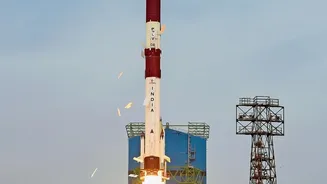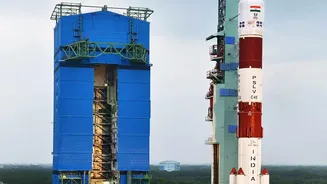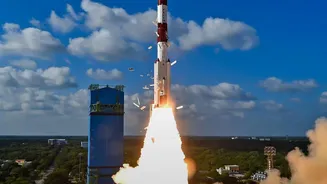




The Ultimate Safety Net
Before we send astronauts into orbit, we must be absolutely certain we can bring them back safely, especially if things go wrong during launch. This is the job of the Crew Escape System (CES), a specialised rocket-powered system designed to do one thing:
pull the crew module and its occupants away from a failing launch vehicle in milliseconds. Think of it as a highly sophisticated ejection seat, not for a single pilot, but for the entire capsule. ISRO has been conducting a series of abort tests—like the Pad Abort Test (PAT) and in-flight abort tests—to validate this critical technology. These tests simulate emergency scenarios, providing the data needed to ensure the CES works flawlessly every single time.
A Symphony of Sensors
Each abort test is a brief, violent, and incredibly data-rich event. The crew module and escape system are fitted with hundreds of sensors—close to 300 in some tests—that act as the mission's nervous system. These sensors record thousands of data points, measuring everything from the intense vibrations and acoustic pressure to the G-forces experienced by the capsule. They track the precise performance of the quick-acting solid motors that power the escape, the sequencing of parachute deployment, and the module's orientation as it tumbles and stabilises. This torrent of information is captured by telemetry and even infrared cameras, ensuring that even if a test occurs in poor weather, every detail is recorded for analysis.
From Data to a Perfect Trajectory
This is where the real work begins. After a test, ISRO engineers dive into the sensor data. Their goal is to understand the real-world performance of the escape system and compare it against their computer models. The data reveals the exact path, or trajectory, the crew module took after separating from the booster. Was the altitude gained sufficient? Did the module fly a safe distance away from the launch area? How accurately did the parachutes guide it to the splashdown zone in the Bay of Bengal? By analysing the actual trajectory, ISRO can refine the flight path for future abort scenarios. This involves tweaking the firing duration of the escape motors and the timing of parachute deployment to create the safest, most stable escape route possible under various failure conditions.
Controlling the Chaos
An abort is a chaotic event. The crew module must be pulled away from an exploding or malfunctioning rocket with immense force—up to 10 times the force of gravity. However, this force must be controlled to protect the astronauts inside. Sensor data helps engineers verify that the g-forces remain within safe limits for humans. Furthermore, the data helps them understand the module's aerodynamics during its uncontrolled tumble before the parachutes deploy. This information is vital for designing the parachute system, which must stabilise a tumbling capsule before slowing it for a gentle splashdown. The data from integrated air drop tests, where the module is dropped from a helicopter, further helps in understanding these dynamics and refining the recovery systems.
Building Confidence, One Test at a Time
Every piece of data from these abort tests feeds into what ISRO calls the Integrated Vehicle Health Management system (IVHM). This is the onboard brain that will, in a real mission, autonomously decide if an abort is necessary. The real-world data from tests helps fine-tune the IVHM's algorithms, teaching it to distinguish a genuine emergency from a minor sensor glitch, thus preventing false alarms while ensuring it acts decisively when needed. Each successful test, from the pad abort in 2018 to the high-altitude test in 2023, is not just a hardware demonstration. It is a crucial step in building a robust, data-proven safety system that gives India the confidence to launch its citizens into the cosmos.