






The Peril of Ascent
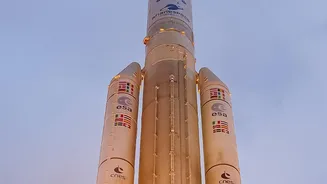
The journey from the launchpad to Earth's orbit is a violent, high-energy event. A rocket is essentially a controlled explosion, harnessing immense power to overcome gravity. For a few minutes, astronauts experience crushing forces and incredible speeds.
If anything goes wrong with the launch vehicle during this critical phase—an engine failure, a structural problem, or a loss of control—the consequences could be catastrophic. The window to react is incredibly small, often just a matter of seconds. This is why having a reliable escape plan isn't just an option; it's a fundamental requirement for any human spaceflight program.
The Astronauts' Lifeboat: The Crew Escape System
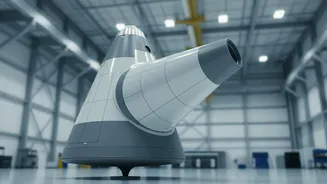
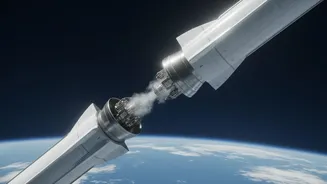
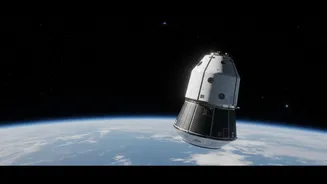
Enter the Crew Escape System (CES), the astronauts' ultimate lifeboat. The CES is a powerful, rocket-powered tower mounted on top of the crew module. Its sole purpose is to pull the capsule and its occupants away from a failing rocket with lightning speed. In the event of an emergency, a series of fast-acting solid motors ignite, generating enormous thrust to separate the crew module and carry it to a safe altitude and distance from the launch vehicle. Think of it as a super-powered ejection seat, but for an entire space capsule. The system is designed to function automatically, detecting anomalies and initiating an abort sequence without any input from the crew or ground control.
Testing for Every Possibility
You can't just build a system like the CES and hope it works. It must be tested relentlessly under the most challenging conditions imaginable. ISRO has planned a series of abort tests to simulate failures at different stages of the launch. The first is the Pad Abort Test (PAT), which simulates an emergency on the launchpad itself, a scenario successfully demonstrated by ISRO. The next level involves in-flight aborts. The Test Vehicle Abort Mission-1 (TV-D1), for example, tested the CES at an altitude of about 17 km and at a speed of Mach 1.2 (faster than the speed of sound). This demonstrated the system's ability to function in the dense lower atmosphere where aerodynamic forces are intense.
The High-Altitude Challenge
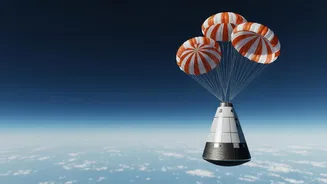
A high-altitude abort presents a different set of challenges. At higher altitudes, the air is thinner, and the rocket is moving much faster. The CES must not only pull the crew module clear but also ensure it can safely reorient itself for a controlled descent. This is followed by a complex parachute deployment sequence designed to slow the capsule from hypersonic speeds. ISRO has conducted Integrated Air-Drop Tests (IADT), dropping a simulated crew module from a helicopter to validate this multi-stage parachute system. These tests ensure that the drogue parachutes correctly stabilize the module before the main parachutes deploy to slow it for a gentle splashdown in the ocean.
Building Confidence for Human Flight
Each of these tests—from the pad to high altitude—provides invaluable data. The information gathered from sensors on the test modules is used to verify computer simulations and confirm that every component, from the separation motors to the parachute mortars, performs exactly as designed. Recent updates from August 2026 confirm that multiple validation milestones have been achieved, including for the CES motors and the deceleration system. This exhaustive, step-by-step validation process is what builds the confidence needed to put human lives on the line. These tests are the bedrock of the Gaganyaan programme's safety-first philosophy, ensuring that when Indian astronauts finally launch, they are protected by one of the most rigorously tested escape systems in the world.