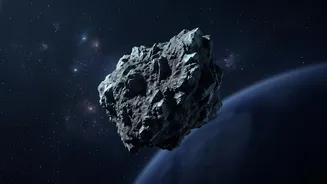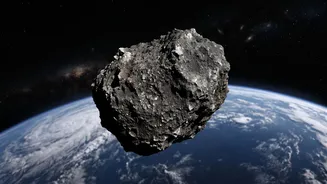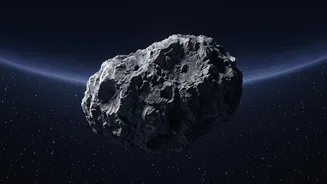



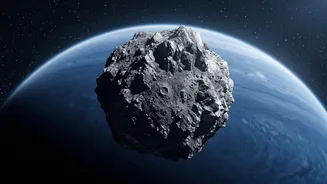
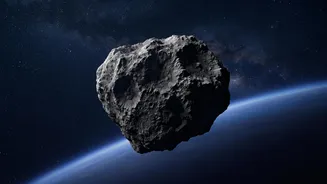
In the vastness of space, a tiny rock is making a big impression. Asteroid 1998 KY26 is not your average space boulder; its blistering speed and strange orbital dance around Earth have captured the attention of scientists globally.
A Tiny Giant of Scientific Interest
First discovered in
1998, 1998 KY26 is a near-Earth asteroid that is surprisingly small. Initial estimates placed it at around 30 metres in diameter, but more recent observations in 2024 have revised its size down to just 11 metres—roughly the size of a small house. Despite its diminutive stature, it holds significant scientific value. Its composition is thought to be similar to carbonaceous chondrite meteorites, which are primitive materials from the dawn of the solar system. Some observations also suggest it may be rich in water. Its small size is comparable to the large boulders seen on the surface of much bigger asteroids like Ryugu and Bennu, making it a crucial link to understanding how these larger bodies are formed and structured.
The Fastest Spin in the Solar System
Perhaps the most startling feature of 1998 KY26 is its incredible rotation speed. The asteroid completes a full rotation in just 5.35 minutes. To put that in perspective, a day on this asteroid is shorter than the time it takes to boil an egg. When first measured, its slightly longer estimated period of 10.7 minutes was already the fastest rotation ever recorded for an object in our solar system. This rapid spin has a profound implication: it cannot be a loose collection of rocks, or what astronomers call a 'rubble pile', held together by gravity. The centrifugal force would tear it apart. Instead, scientists believe 1998 KY26 must be a monolithic body—a single, solid chunk of rock with enough internal strength to withstand the immense rotational stress.
An Unusual Orbital Dance
While its spin is record-breaking, its orbit is equally bizarre. 1998 KY26 is classified as an Apollo asteroid, meaning its path crosses Earth's orbit. However, it also engages in a special type of co-orbital configuration where it becomes a 'quasi-satellite' of Earth. This doesn't mean it orbits Earth like the Moon. Instead, it orbits the Sun on a path so similar to our own that, from our perspective, it appears to loop around our planet in a corkscrew pattern. This relationship is temporary; these quasi-satellites can remain in this dance for hundreds of years before drifting into a different orbital path. This unusual orbital proximity makes 1998 KY26 one of the most accessible asteroids for a spacecraft mission from Earth.
A Target for Japan's Hayabusa2
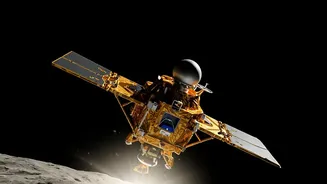
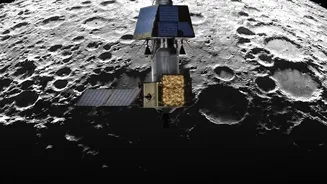
Recognising its unique scientific potential, the Japan Aerospace Exploration Agency (JAXA) has selected 1998 KY26 as the final target for its highly successful Hayabusa2 mission. After famously collecting samples from asteroid Ryugu, the spacecraft is now on an extended mission. It is scheduled to rendezvous with 1998 KY26 in July 2031. This will mark the first time a spacecraft has visited a decametre-sized asteroid, offering an unprecedented closeup view of this class of object. Scientists hope to understand the asteroid's composition, its physical properties, and the forces acting upon it. The rapid rotation and small size will present significant challenges for the mission, particularly if it attempts to land.
Solving a Cosmic Mystery
Further adding to the intrigue is an unexplained acceleration observed in the asteroid's path, perpendicular to its orbital plane. This kind of movement can sometimes be caused by outgassing—when ice within a body turns to gas and escapes, creating a tiny rocketlike push. This led some to classify 1998 KY26 as a potential 'dark comet'. However, recent modelling suggests the asteroid is too warm for water ice to survive for long, casting doubt on this theory. Other theories suggest this acceleration could be caused by other forces or even an illusion created by observation biases. Answering these questions is not just an academic exercise. Studying an object of this size, which is comparable to the impactors that caused the Tunguska and Chelyabinsk events, is vital for planetary defence.