

1. It Is A Brand-New Discovery
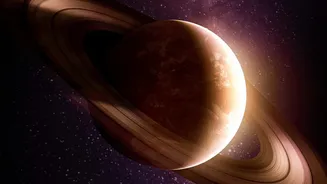
For over 40 years, Saturn's north pole has hogged the spotlight with its famous hexagonal storm, a six-sided jet stream first spotted by the Voyager spacecraft in the 1980s. Scientists had long searched for a similar feature at the south pole but found
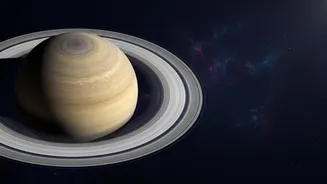
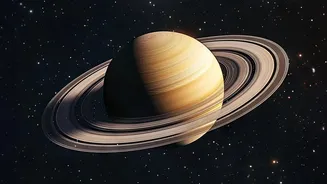
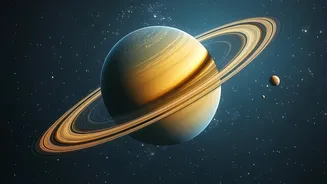
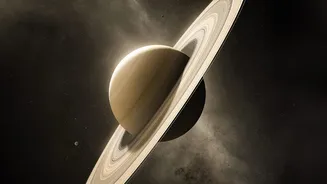
nothing. That all changed very recently. Thanks to the keen eye of the Hubble Space Telescope, astronomers have confirmed the existence of a decagon, a massive 10-sided atmospheric wave swirling around the southern pole. The discovery was officially announced in early September 2026, based on an analysis of images captured between 2023 and 2025. Unlike the long-lived hexagon, this decagon appears to be a new development, giving us a rare chance to watch a massive planetary weather system being born. It’s a powerful reminder that even giant planets we think we know can be dynamic and full of change.
2. It Has A Sibling, But They Are Not Twins
While the discovery of another polygon on Saturn suggests such shapes might be more common than we thought, the new decagon is distinctly different from its northern sibling. The most obvious difference is the number of sides: ten in the south versus six in the north. The northern hexagon is a remarkably stable feature, having persisted for the entire 40-plus years we’ve been observing it. The southern decagon, by contrast, seems to be a new and evolving phenomenon that has only strengthened in the last few years. The hexagon is located at a latitude of about 78°N, while the decagon swirls around 60°S. These differences tell scientists that while the underlying physics might be similar, the specific conditions in each hemisphere are creating unique and spectacular results. They are less like identical twins and more like two very different siblings.
3. Teamwork Made The Dream Work
This incredible discovery wasn't made by a single person staring through a telescope. It was a fantastic example of modern scientific collaboration. The first clues came from a network of amateur and professional astronomers who contribute images to a project called the Planetary Virtual Observatory Laboratory. In 2024, observers including Trevor Barry and Jean-Paul Oger noticed a faint, wavy pattern near the south pole in their ground-based images. This prompted professional researchers to take a closer look using the powerful Hubble Space Telescope. By analyzing several years of high-resolution images from Hubble's Outer Planet Atmospheres Legacy (OPAL) program, which annually monitors our solar system's outer planets, they were able to confirm the feature and trace its development from a subtle wave in 2023 to a defined decagon.
4. It Is A Massive Three-Dimensional Wave
The headline is right: this is not just a cloud. The decagon is a colossal atmospheric wave, a disturbance propagating through Saturn's atmosphere. It’s a bit like the jet streams on Earth that influence our weather, but on an almost unimaginable scale. The structure is part of a powerful jet stream racing around the planet at speeds of roughly 400 to 420 kilometers per hour. Furthermore, observations in different wavelengths of light show that the decagon isn't just a flat pattern on the cloud tops. It is a deep, three-dimensional structure that extends vertically through several layers of the atmosphere. This vertical structure is crucial because it tells scientists that the phenomenon is a fundamental part of the planet's atmospheric dynamics, not just a superficial feature.
5. Its Existence Is A Giant Mystery
The biggest question on every scientist's mind is: why now? After decades of observing Saturn, including 13 years of constant surveillance from the Cassini spacecraft which saw no such structure, a giant ten-sided storm has suddenly appeared. Researchers are buzzing with excitement because its formation challenges our understanding of how giant planet atmospheres work. One leading idea is that its formation may have been triggered by a powerful, nearby storm—an anticyclone vortex rotating near the decagon. But the exact cause remains unknown. Scientists now plan to use both the Hubble and the James Webb Space Telescopes to continue monitoring the decagon. They hope to determine what created it, whether it will stabilize like the northern hexagon, and what it can teach us about the complex physics that govern the weather on other worlds.