



What Exactly Is the Crimson Nebula?
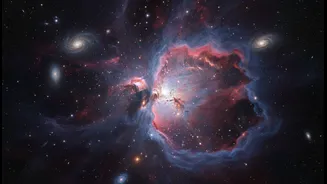
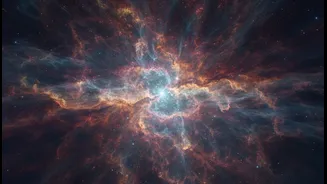
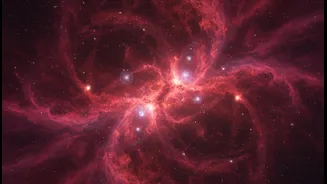
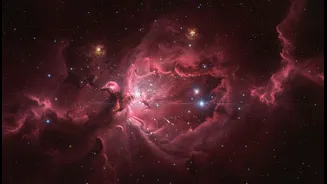
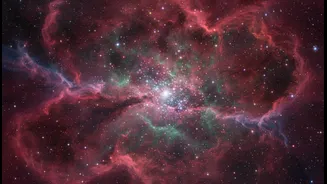
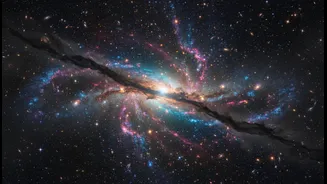
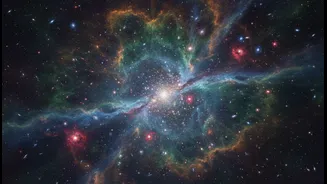
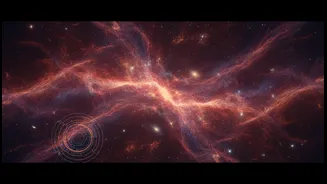
While “Crimson Nebula” is a fittingly dramatic name, it isn't an official astronomical designation for a single object. Instead, it perfectly describes the appearance of several star-forming regions where gas, particularly hydrogen, is energized and made
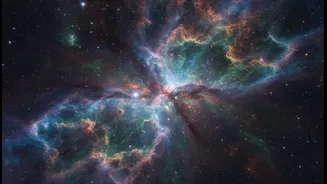
to glow a brilliant red. One of the most famous examples is the Carina Nebula (NGC 3372), located about 7,600 light-years from Earth. Recent images from the James Webb Space Telescope (JWST) have focused on a stunning portion of this nebula nicknamed the “Cosmic Cliffs,” which perfectly embodies this crimson character. This vast landscape of gas and dust is a stellar nursery, a place where new stars are being born.
A Workshop for Building Stars
At its heart, a nebula like Carina is an immense cloud of cold gas and dust. Within these clouds, gravity begins to pull material together into dense clumps. As these clumps grow, the pressure and temperature at their cores rise dramatically. Eventually, they become so hot and dense that nuclear fusion ignites, and a new star is born. These infant stars, known as protostars, are often hidden from view by the very dust clouds that created them. This is where modern observatories like the JWST excel. By observing in infrared light, these telescopes can peer through the obscuring dust to witness the star formation process directly, revealing hundreds of previously hidden stars. This process of star birth is a rare event to capture, lasting only about 50,000 to 100,000 years for an individual star.
Creative Destruction on a Cosmic Scale
The story doesn't end with a star’s birth. The most massive young stars within the nebula are incredibly hot and powerful. They unleash intense ultraviolet radiation and ferocious stellar winds that blast into the surrounding gas and dust. This is a process of creative destruction. On one hand, this powerful radiation erodes the nebula, carving out vast cavities and sculpting the gas into the dramatic pillar and cliff-like shapes we see. The 'steam' that appears to rise from the Cosmic Cliffs is actually hot gas and dust being stripped away by this relentless energy. On the other hand, the shockwaves from these stellar winds can compress the gas in other parts of the nebula, triggering a new wave of star formation. It's a delicate balance between creation and destruction, all happening on a scale almost too vast to comprehend.
A Glimpse Into Our Own Cosmic Past
Studying a dynamic region like the Carina Nebula is more than just an academic exercise; it’s like looking at a page from our own cosmic family album. Our own Sun and solar system are believed to have formed in a similar type of stellar nursery about 4.6 billion years ago. By observing the processes in Carina—the collapse of gas clouds, the ignition of protostars, and the influence of massive stars on their environment—astronomers gain invaluable insights into the conditions that led to our own existence. These distant, glowing clouds are a laboratory for understanding how planetary systems form and how galaxies evolve. Each stunning image is a snapshot of the fundamental cycle of matter in the universe, providing clues to our origins and the ongoing story of the cosmos.