




Meet the 'Steam World'
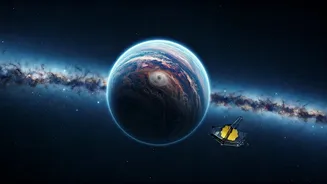
The planet in question is GJ 9827 d, located nearly 100 light-years away in the constellation Pisces. Roughly twice the diameter of Earth, this exoplanet is unlike anything in our solar system. While initial hints of water were detected by the Hubble
Space Telescope, it took the unparalleled sensitivity of the James Webb Space Telescope (JWST) to confirm the discovery in stunning detail. The findings reveal an atmosphere not just containing traces of water, but one that is incredibly rich in it, leading some scientists to nickname it a 'steam world'. This makes GJ 9827 d the smallest exoplanet to date where a water-rich atmosphere has been so clearly detected and validated.
How Webb Reads the Skies
So how does a telescope nearly 100 light-years away taste the air of another world? The technique is called transit spectroscopy. As GJ 9827 d passed in front of its host star from our perspective, the JWST carefully measured the starlight that filtered through the planet's atmosphere. Different molecules absorb light at specific wavelengths. Water, in particular, leaves a very distinct chemical fingerprint on the light spectrum. The instruments on Webb, specifically its Near-Infrared Imager and Slitless Spectrograph (NIRISS), are so exquisitely sensitive they can detect these subtle dips in starlight, allowing scientists to identify the molecular makeup of the atmosphere. Previous attempts to study similar planets often resulted in flat, featureless readings, possibly due to thick hazes or clouds. The clear signal from GJ 9827 d is a testament to Webb's extraordinary capabilities.
A Steamy, Not-So-Hospitable World
Before we start imagining oceans and Earth-like vistas, it is important to manage expectations. GJ 9827 d is not a candidate for a holiday destination. It orbits its star very closely, completing a full 'year' in just over six Earth days. This proximity results in a scorching surface temperature of around 430 degrees Celsius, comparable to Venus. At this temperature, any water would exist as a vast, high-pressure steam blanket. Life as we know it could not survive under such conditions. The immense value of this discovery isn't that this specific planet is habitable, but that it proves such water-rich atmospheres can exist and, crucially, that we now have the technology to detect them.
The Search for Earth's Twin
This discovery is a monumental step in the broader search for life. For decades, scientists have theorised the existence of 'water worlds', and GJ 9827 d is the first confirmed example. It helps bridge a major gap in our understanding of planets that are sized between Earth and Neptune, a class of planet that is common in the galaxy but absent in our own solar system. By studying a 'steam world' up close, astronomers can refine their models of planetary formation and evolution. The key takeaway is this: if Webb can find water so definitively on a small, hot world, it has an excellent chance of finding it on a temperate, rocky planet that lies within its star's habitable zone—the region where liquid water could potentially exist on a planet's surface.
What Comes Next?
The work on GJ 9827 d is far from over. Future observations with the JWST will aim to flesh out the complete inventory of molecules in its atmosphere. Scientists will be hunting for carbon-bearing molecules like methane and carbon dioxide, which can provide further clues about the planet's formation and history. Each new discovery, each validated signal, serves as a crucial dress rehearsal for the ultimate goal: analysing the atmosphere of a true Earth-analogue. This 'steam world' has proven that the telescope and the techniques work. Now, the hunt is on for a world where that water vapour might condense into rain, filling rivers and oceans on a planet much like our own.