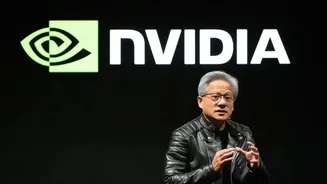







The sudden, sharp drop in technology stocks this November has sent a chill through the market, with trillions wiped from valuations in a matter of days. It’s a sea of red that has many asking: is the great AI boom finally going bust?
An Alarming Sell-Off
Last week, the tech-heavy
Nasdaq index suffered one of its worst single-day drops since 2020, plunging over 5%. The sell-off was particularly brutal for companies at the heart of the AI revolution. Semiconductor giant Nvidia saw its stock fall sharply, alongside other major players in the chip and data center space. The Philadelphia Semiconductor Sector index, a key benchmark for chip stocks, recorded one of its biggest daily losses in years. This wasn't just a minor dip; it was a violent market event that erased months of gains and prompted fears that the AI investment cycle was coming to an abrupt and painful end.
Political Triggers and Crowded Trades
The immediate catalyst for the rout appeared to be the results of the US midterm elections. Investors grew concerned that a new political landscape could lead to tighter regulations and a slowdown in the construction of massive, power-hungry AI data centers. However, this political uncertainty merely lit the fuse on a market that was already primed for a correction. For months, analysts had warned that the AI trade was becoming dangerously crowded. After a period of intense hype, valuations had stretched to astronomical levels, with some comparing the frenzy to the dot-com bubble. This sell-off was amplified by investors using leverage, or borrowed money, who were forced to sell their holdings to cover losses, creating a vicious downward spiral.
A Repricing, Not a Fundamental Failure
This is where the distinction between price and progress becomes crucial. While stock prices have plummeted, the underlying fundamentals of the AI industry have not changed overnight. Many market experts argue this is not a collapse of AI technology but a necessary and overdue repricing of risk in the stock market. Adam Patti, CEO of VistaShares, noted that this is a 'valuation and sentiment reset, not a change in fundamentals'. Similarly, analysts at Bernstein expressed long-term optimism, suggesting the current weakness is a temporary fluctuation. For months, the market had priced AI stocks for perfection, ignoring risks like high borrowing costs, massive capital expenditures, and uncertain timelines for return on investment. The November rout was the market suddenly waking up to these realities.
The Difference From the Dot-Com Bust
While comparisons to the dot-com bubble of the late 1990s are easy to make, there are fundamental differences. During the dotcom era, many companies had sky high valuations with little to no actual profit or revenue to support them. Today's AI leaders, while facing a stock correction, are generating substantial earnings. The current spending on AI infrastructure is driven by real, measurable demand for computing power. Unlike the purely speculative boom of 2000, the current AI investment cycle is translating into real productivity gains and cash flow for many companies, even if investors are now questioning the pace and cost of that expansion.
A More Sober Path Forward
The selloff is forcing a necessary dose of realism into the AI narrative. Investors are becoming more selective, distinguishing between hype and real world execution. Questions about profitability, capital efficiency, and the immense power requirements for data centers are now front and center. This doesn't mean the AI revolution is over. On the contrary, analysts from firms like UBS Global Wealth Management believe the investment cycle remains intact, viewing the current downturn as 'market indigestion' rather than a long term crisis. The path forward for AI stocks may be more volatile, but it will also be more grounded in financial reality.