



The Orbital Junkyard
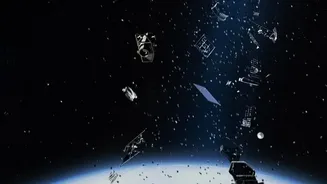
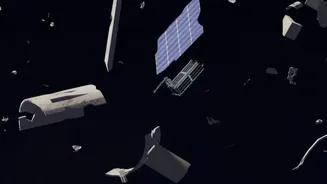
Tens of thousands of tracked objects—and millions of smaller, untraceable fragments—are currently whipping around our planet at speeds exceeding 28,000 kilometres per hour. In low Earth orbit (LEO), even a paint chip can strike with the force of a hand
grenade, posing a catastrophic risk to active satellites that power everything from GPS to global communications and weather forecasting. This growing cloud of debris has raised fears of the Kessler Syndrome, a theoretical scenario where collisions create a cascade of more debris, eventually making parts of orbit unusable for generations. This isn't just a future problem; collisions have already happened, and the urgency to clean up our cosmic backyard is fueling a new commercial industry dedicated to orbital sanitation.
The Aggressive Approach: Harpoons and Nets
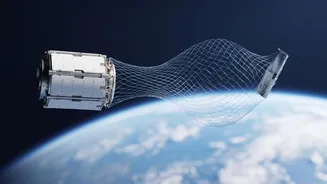
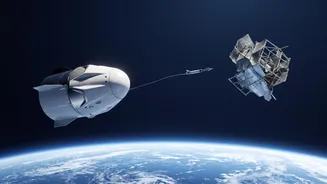
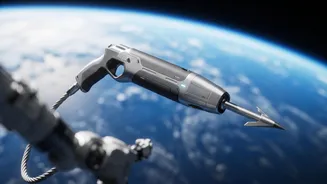
One of the most direct methods for capturing large, uncooperative debris like a dead satellite or a spent rocket stage involves physical contact. Imagine a cosmic chase where a specialized 'servicer' spacecraft pursues its target. The British-led RemoveDEBRIS mission, which concluded years ago, successfully tested two concepts that sound like they're straight out of science fiction: a harpoon and a net. The harpoon fires a projectile to impale the target, securing a firm connection for towing. The net is designed to ensnare a tumbling object, wrapping around it to gain control. While effective, these methods carry risks. A misfired harpoon or a net that fails to close properly could inadvertently create more debris or send the target spinning in an even more unpredictable way.
A Gentler Touch: Claws and Magnets
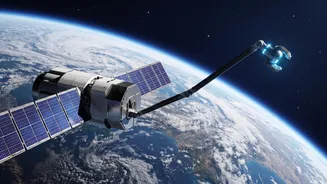
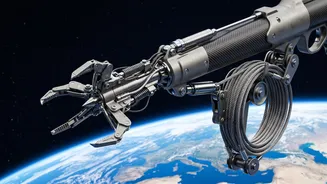
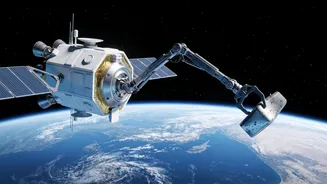
For a less aggressive but equally complex capture, companies and agencies are developing robotic arms and magnetic docking systems. The European Space Agency (ESA) is commissioning the ClearSpace-1 mission, which will use a four-armed 'claw' to gently embrace and capture a defunct satellite. The mission, expected to launch in 2028, will demonstrate the ability to rendezvous with and deorbit an object that wasn't designed to be captured. Meanwhile, the Japanese company Astroscale has successfully demonstrated magnetic capture with its ELSA-d mission. Its technology uses a magnetic plate on the servicer to dock with a corresponding plate on a satellite, a feature future satellites could include to make end-of-life removal far simpler. This 'design for removal' philosophy is a key part of making space operations more sustainable.
The Hands-Off Methods: Lasers and Tugs
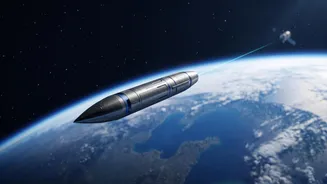
What if you could move a piece of junk without even touching it? That's the idea behind laser ablation. This method involves a ground-based or space-based laser firing precise pulses at a piece of debris. The laser's energy vaporizes a tiny layer of the object's surface, creating a small puff of gas that acts as a micro-thruster, gently nudging the object over time into a lower orbit where it will burn up in the atmosphere. While still largely theoretical for active removal, the concept avoids the risks of physical contact. Another developing concept is the 'space tug,' a robust vehicle that could capture a piece of debris and then use its own powerful engines to drag it into a disposal orbit or directly into a controlled reentry path over an uninhabited area like the South Pacific Ocean.
The Business of a Cleaner Orbit
Cleaning up space isn't just an environmental issue; it's a burgeoning business. A host of startups and established aerospace giants are entering the field of active debris removal (ADR) and on-orbit servicing. Companies like Astroscale, ClearSpace, Paladin Space, and others are developing technologies not just for removal but also for satellite life extension and inspection. NASA has also developed its own Active Debris Removal Vehicle concept. However, significant hurdles remain. The cost of a single removal mission can be enormous, and complex questions of international law and liability persist—after all, who is responsible for a defunct satellite, and who pays for its removal? As private companies launch mega-constellations of thousands of satellites, the need for clear rules and commercially viable cleanup solutions has never been more critical.