





Decoding the Invisible Universe
So, what exactly is infrared light? Think of it as a type of light our eyes can't see, but we can often feel as heat. On the electromagnetic spectrum, its wavelengths are longer than visible light. This characteristic is crucial for astronomy. While visible light gets
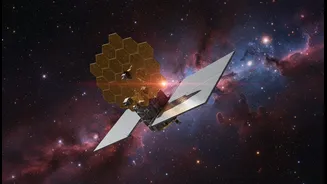
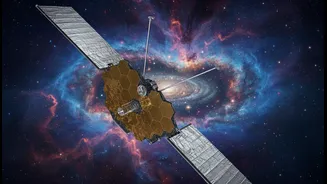
blocked and scattered by particles of cosmic dust, the longer wavelengths of infrared light can slip right through. This gives Webb an ability that feels like a science-fiction superpower: it can peer directly into dense clouds of gas and dust that are completely opaque to telescopes like Hubble, which primarily sees in visible and ultraviolet light. This allows scientists to witness processes that were previously shrouded in mystery.
A Telescope and a Time Machine
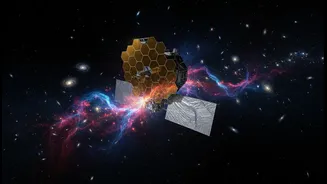
One of Webb's most celebrated abilities is looking back in time, and infrared is the key. Because light takes time to travel vast cosmic distances, looking at faraway objects is literally looking into the past. The universe has been expanding since the Big Bang, and this expansion stretches the light waves traveling through it. Light from the very first stars and galaxies, which was originally emitted as visible or ultraviolet light, has been stretched over billions of years into infrared light by the time it reaches us. This phenomenon is called "cosmological redshift." To see the dawn of the cosmos—the first luminous objects to ever exist—we have to look for this ancient, stretched-out infrared light. Webb was specifically designed to capture it.
X-Ray Vision for Cosmic Clouds
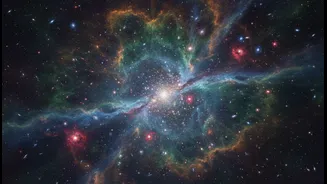
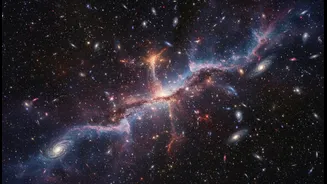
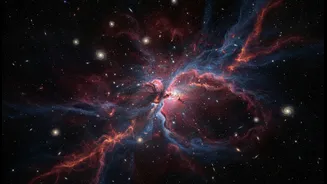
Many of the universe's most dramatic events, like the birth of stars and planets, happen inside thick, dusty nebulas. To visible-light telescopes, these stellar nurseries are like impenetrable walls of fog. But for Webb's infrared instruments, it's a different story. Infrared light's ability to penetrate this dust gives astronomers a front-row seat to the formation of new stars and their planetary systems. Recent images have showcased this power, revealing bright, young protostars that were previously hidden. By detecting the heat glow from these nascent objects and the surrounding dust, Webb provides unprecedented detail about how solar systems come into being, fundamentally changing our understanding of star formation.
Searching for Signs of Life
Beyond seeing distant galaxies and newborn stars, infrared is also a powerful tool for studying exoplanets—planets orbiting other stars. While these planets are too cool to shine in visible light, they do emit heat in the form of infrared radiation. This allows Webb to detect them directly. More importantly, when an exoplanet passes in front of its star, some of the starlight filters through the planet's atmosphere. Webb's instruments can analyze this light, looking for the chemical fingerprints of specific molecules like water, methane, and carbon dioxide. These atmospheric components are essential for understanding a planet's climate and whether it might have the right conditions to support life, bringing us one step closer to answering the question of whether we are alone in the universe.