

The Ultimate Safety Net
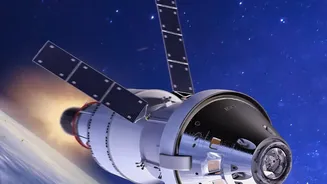
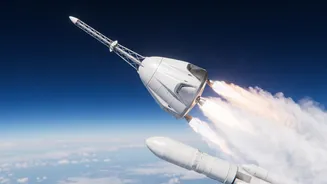
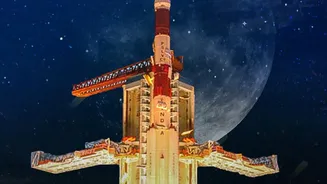
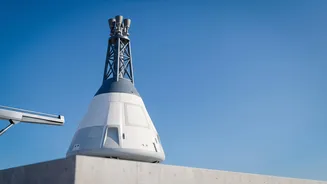
Human spaceflight is an inherently risky endeavour, especially during the violent ascent phase. The Crew Escape System (CES) is a critical safety mechanism designed as a space-age ejection seat. Its sole purpose is to pull the crew module—the capsule
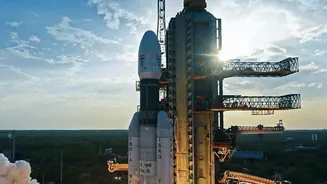
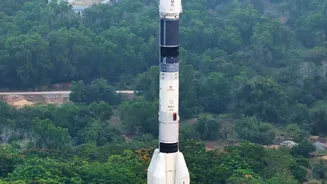
carrying the astronauts—away from a failing launch vehicle in milliseconds. Positioned at the very top of the human-rated LVM3 rocket, the CES is equipped with a set of powerful, quick-acting solid-propellant motors. If the onboard computers detect a catastrophic anomaly, like a loss of thrust or a structural failure, the CES is designed to fire and propel the crew to a safe distance before the main rocket fails completely.
Thrusters Built for a Single, Vital Job
The thrusters in the Crew Escape System are unlike any other rocket engine. They don't need to burn for long, but they need to ignite instantly and provide immense, controlled power. These special-purpose solid motors use high burn-rate propellants that generate acceleration far greater than the main launch vehicle itself. In the case of Gaganyaan, the CES could subject the crew to forces of up to 10 times that of gravity for a few crucial seconds. The system comprises several motors with specific roles, including the Low Altitude Escape Motor (LAEM) and High Altitude Escape Motor (HEM), which fire depending on the stage of the flight. This precision ensures the crew module is not just pushed away, but steered onto a safe trajectory for recovery.
A Milestone in Precision Engineering
The latest series of ground qualification tests represents a significant achievement in Gaganyaan’s safety engineering. Proving the 'precision' of these thrusters isn't just about ensuring they fire; it's about validating that they fire with the exact impulse, at the exact moment, to guide the capsule safely away without causing harm to the crew or the module. These ground qualification tests for the CES motors have now been completed. This follows a series of successful demonstrations, including a Pad Abort Test in 2018 and a critical in-flight abort test in October 2023, where the CES successfully pulled the module away from a test vehicle travelling at 1.2 times the speed of sound. Each test validates the system's reliability under different failure scenarios.
Why This Test is Crucial for Gaganyaan
Successfully qualifying the Crew Escape System's thrusters is a non-negotiable step before humans can fly on the Gaganyaan spacecraft. It's one of the final and most complex pieces of the safety puzzle. With the propulsion stages of the Human-rated LVM-3 rocket and various parachute systems also validated, ISRO is systematically ticking off the boxes required for a human-rated mission. This success builds confidence not just within ISRO, but across the global space community, demonstrating India's commitment to astronaut safety above all else. It signals that the programme is maturing from component-level development to integrated system readiness.
The Road to India’s First Human Spaceflight
With this critical safety milestone achieved, ISRO is advancing toward the next phases of the Gaganyaan programme. The immediate goal is the first uncrewed test flight, which will validate the performance of all systems in a real-world space environment. This mission, currently targeted for late 2026, will serve as a full dress rehearsal. Following a series of uncrewed flights to prove the system's reliability, the historic crewed mission is targeted for 2027. This will see three Indian astronauts launch into a 400 km orbit for a three-day mission, culminating in a safe splashdown in Indian waters. These efforts are not just about a single launch; they are the foundation for India's long-term ambitions, including a sustained human presence in space with the Bharatiya Antariksh Station planned for 2035.