


The Moon's Hidden Havens
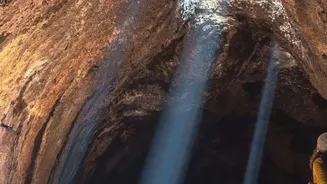
Billions of years ago, when the Moon was volcanically active, rivers of molten rock flowed across its surface. In some cases, the top layer of this lava cooled and solidified while the molten river beneath drained away, leaving behind vast, hollow tunnels.
These are lava tubes. Scientists have identified hundreds of pits on the lunar surface that are likely 'skylights'—collapsed sections of roof that serve as natural doorways into these subterranean networks. Some of these tubes are thought to be enormous, potentially stretching for hundreds of kilometers with diameters large enough to house entire cities. Their existence has shifted from a geological curiosity to a cornerstone of future lunar settlement plans.
A Relentless Cosmic Barrage
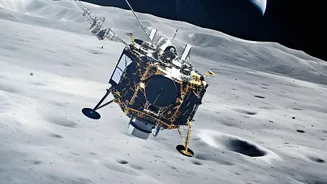
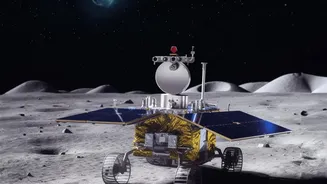
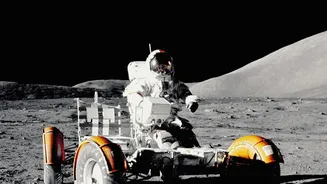
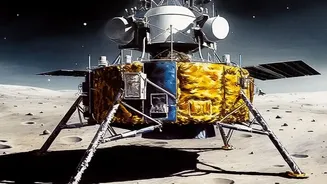
Unlike Earth, the Moon has no substantial atmosphere and no global magnetic field to protect it. This leaves its surface exposed to a constant bombardment of dangerous radiation from two primary sources: galactic cosmic rays (GCRs) from deep space and sporadic solar particle events (SPEs) from our own Sun. Measurements from China's Chang'e 4 lander revealed that radiation levels on the Moon are about 200 times higher than on Earth's surface. An astronaut on the Moon would receive a radiation dose 2.6 times higher than someone on the International Space Station. This level of exposure poses a significant risk of cancer and other long-term health problems for anyone hoping to stay on the Moon for extended periods.
Nature's Perfect Bomb Shelter
This is where lava tubes become a game-changer. The thick ceilings of solid volcanic rock and overlying regolith provide superb natural shielding. Studies suggest that just a few meters of overburden could reduce the radiation dose from GCRs down to terrestrial levels, making the environment inside the tube safe for long-term habitation. Beyond radiation, these caverns offer protection from other lunar hazards. They shield against micrometeorite impacts, which can strike the surface at incredible speeds. Furthermore, they provide a remarkably stable thermal environment. While the lunar surface swings between scorching heat and freezing cold over its two-week day-night cycle, the temperature inside a lava tube remains nearly constant, likely around a chilly but manageable -20°C.
Missions to Map the Underworld
Multiple space agencies are actively developing missions to explore these promising structures. NASA's Artemis program, which aims to establish a long-term human presence on the Moon, views lava tubes as prime locations for future infrastructure. The agency has funded concepts like the Lunar Underground eXplorer (LUX), a laser-powered drone designed to descend into a pit and survey the cave network. The European Space Agency (ESA) is also heavily invested. Through its PANGAEA program, which trains astronauts in field geology, ESA is testing technologies and operational concepts for cave exploration in volcanic landscapes on Earth, like those in Lanzarote, Spain. ESA has also supported studies for missions like Daedalus, a spherical probe that would be lowered into a pit to create 3D maps of the interior.
The Challenge of the Descent
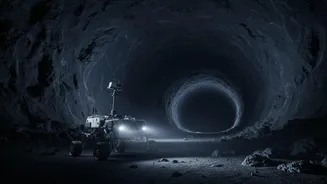
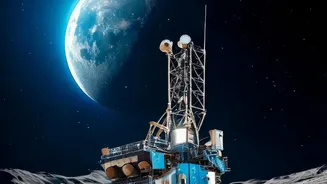
Despite their immense potential, utilizing lava tubes presents significant technical hurdles. The first challenge is simply finding accessible entrances and confirming that they lead to stable, extensive tunnels. Once identified, missions must safely navigate the descent. This could involve robotic cranes lowering rovers or tethered probes like the proposed AXEL rover from NASA's Jet Propulsion Laboratory. Exploring the dark, unknown, and potentially treacherous terrain inside requires autonomous robots that can navigate without GPS and transmit data back to the surface, likely through a relay station positioned at the entrance. Power is another issue, as solar-powered rovers would be useless in the permanent dark of a cave, necessitating alternative power sources or wireless charging systems.