



The Orbital Path: A Cosmic Fingerprint
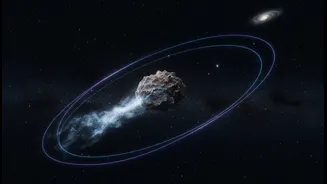
One of the most reliable ways to tell a comet from an asteroid is to look at its orbit around the Sun. Most asteroids live in a relatively crowded neighbourhood called the Asteroid Belt, a ring of debris located between Mars and Jupiter. Their paths are
typically similar to those of planets: fairly circular and on the same plane as Earth's orbit. In contrast, comets are long-haul travellers. Many originate in the far, frozen reaches of the solar system, in regions known as the Kuiper Belt and the more distant Oort Cloud. Their orbits are often highly eccentric, or stretched-out, resembling massive ovals. This elongated path means they swing in close to the Sun for a brief, fiery visit before heading back to the cold outer solar system, a journey that can take anywhere from a few decades to hundreds of thousands of years.
A Tale of Two Tails (Or None at All)
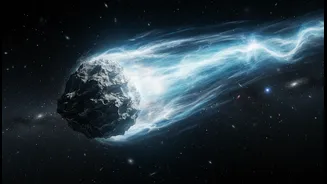
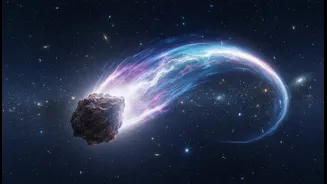
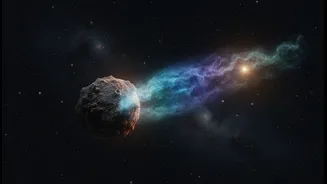
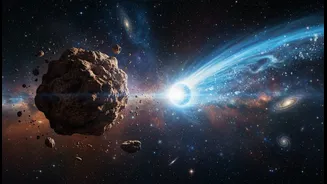
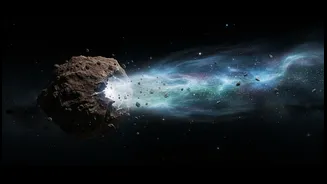
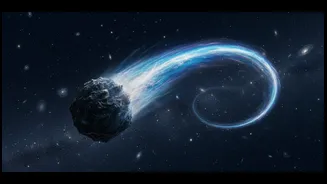
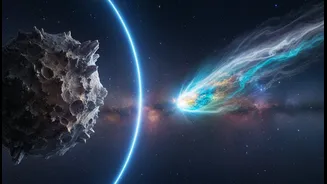
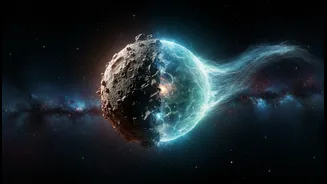
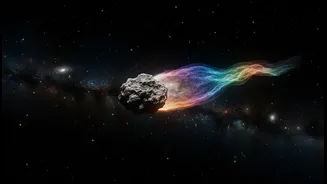
The most iconic feature of a comet is its magnificent tail, but it's a feature they only develop when their journey brings them close to the Sun. For most of their orbit, comets are frozen, inactive chunks of ice and rock. As a comet approaches the Sun, the heat causes its volatile ices—like water, carbon dioxide, and ammonia—to sublimate, or turn directly from solid to gas. This process creates a glowing atmosphere around the nucleus called a coma. Solar radiation and solar wind then push this gas and accompanying dust away from the comet, forming two distinct tails: a straight gas (or ion) tail and a curved dust tail. Asteroids, being mostly rock and metal, generally don't have tails because they lack the large quantities of ice needed to create a coma. They were formed much closer to the Sun, where it was too warm for ices to remain solid.
The Volatile Clues: Ice vs. Rock
At their core, the differences between comets and asteroids come down to their composition—the "volatile clues" from their formation 4.6 billion years ago. Comets are often called "dirty snowballs" because they are a primordial mix of ice, dust, and frozen gases like carbon monoxide and carbon dioxide. These volatile materials are a time capsule, preserving the ingredients of the early solar system in a deep freeze. Asteroids, on the other hand, are primarily made of rock and metals, similar to the building blocks of planets like Earth. They are leftovers from the formation of the inner planets. This fundamental difference in makeup is what drives all the other distinctions; a comet's icy nature is why it forms a coma and tail, while an asteroid's rocky composition means it generally remains an inert, star-like point of light in a telescope.
Avoiding Common Cosmic Pitfalls
While these rules are excellent guides, modern astronomy has revealed that the line between comets and asteroids can sometimes be blurry. One common mistake is assuming anything with a tail must be a comet. Scientists have discovered a class of objects called "active asteroids" or "main-belt comets." These objects have asteroid-like orbits within the main belt but can surprisingly exhibit comet-like activity, such as forming a tail. This can be caused by impacts exposing subsurface ice or other non-sublimation processes. Another misconception is that all comets have visible tails all the time. In reality, a comet only displays its tail during the small portion of its orbit when it is close enough to the sun to heat up. Understanding these exceptions helps refine our knowledge and appreciate the dynamic and evolving nature of the small bodies in our solar system.