


What Exactly Is Hitting the Moon?
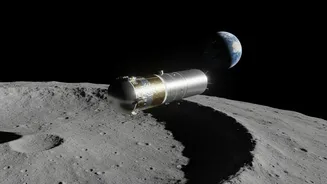
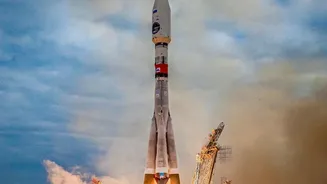
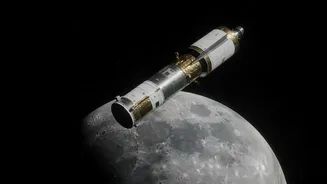
The object in question is the upper stage of a SpaceX Falcon 9 rocket. This component helped launch two lunar landers in January 2025 before being discarded. Since then, it has been in a chaotic orbit. Initially discovered by asteroid surveys, its trajectory
was meticulously tracked by astronomers, including Bill Gray of Project Pluto, who first predicted its eventual collision course with the Moon. Unlike natural meteors, which are often of unknown size and composition, this 4-ton, 45-foot-long piece of man-made debris gives scientists a rare, controlled experiment. They know its mass and materials, providing a unique chance to study how artificial objects create craters on the lunar surface.
The Science of a Prediction
Predicting an impact like this is a marvel of modern astronomy. The process starts with discovery, usually by wide-field telescopes that scan the sky nightly for new or moving objects. Once an object is spotted, astronomers take multiple observations to establish an 'observation arc'—a plot of its movement over time. Using the laws of orbital mechanics, computers can then calculate a probable path. The more data points collected over a longer period, the more accurate the orbital model becomes. For this Falcon 9 stage, initial projections made in late 2025 were refined over months, leading to NASA confirming a 100% chance of impact. This process is handled by dedicated bodies like NASA's Center for Near-Earth Object Studies (CNEOS) and the international Minor Planet Center.
Why Isn't It an Exact Science?
Despite the success in predicting this impact, pinpointing the exact location and second of collision remains a challenge. Several factors introduce uncertainty. For man-made debris, the hollow, tumbling nature of a spent rocket stage makes its path slightly erratic. Its rotation can cause brightness to fluctuate, making it tricky to track consistently. Furthermore, forces like solar radiation pressure—the gentle push of sunlight—can subtly alter the trajectory of a light, hollow object over months. Even calculating the orbits of natural asteroids isn't perfect. Small sizes, dark surfaces, and coming from the direction of the Sun can make them difficult to spot. This is why continuous tracking is crucial; a prediction is not a one-time calculation but an evolving forecast that improves with every new observation.
A Valuable Scientific Opportunity
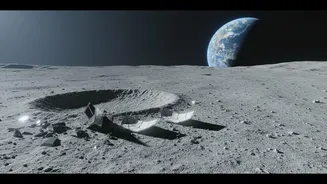
While the impact itself won't be visible to the naked eye, it's a significant scientific event. Researchers hope to observe the 'ejecta plume'—the cloud of lunar dust and rock kicked up by the collision—with powerful telescopes. This plume, which could rise tens of kilometers, will reveal information about the composition of the lunar surface in the impact zone near Einstein crater. Studying how a hollow object creates a crater, as opposed to a solid rock, helps calibrate models used for all future impacts, both natural and artificial. NASA's Lunar Reconnaissance Orbiter will later photograph the resulting crater, which is expected to be about 60 feet wide, providing a permanent record of the event.
What This Means for Planetary Defense
Tracking space junk and near-Earth objects (NEOs) is about more than just scientific curiosity; it's a cornerstone of planetary defense. Every piece of debris, from tiny fragments to large rocket stages, poses a collision risk to operational satellites and future space missions. The systems and methods used to track this Falcon 9 stage are the same ones used to search for potentially hazardous asteroids. While no known large asteroid poses a threat for the next century, less than half of the estimated 25,000 NEOs larger than 140 meters have been found. Each prediction, whether for a small piece of debris or a massive asteroid, refines the techniques that help keep our space assets—and eventually, our planet—safe from harm.