




A New World Comes Into Focus
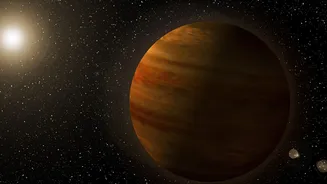
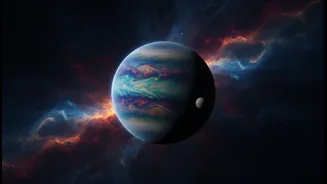
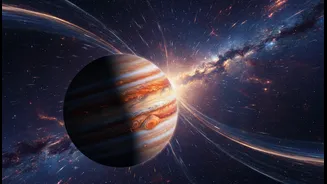
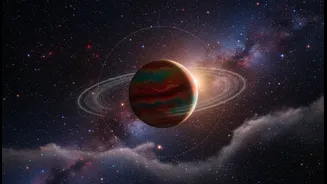
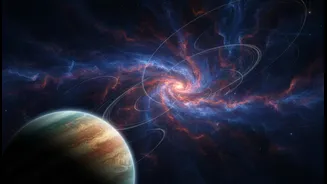
Astronomers have confirmed the existence of a new exoplanet, named Gaia23bra b, for the first time using data from NASA's TESS satellite in a novel way. This isn't your typical exoplanet discovery. Gaia23bra b is a behemoth, a 'super-Jupiter' with about
1.6 times the mass of our own gas giant. It orbits its star, an orange dwarf, at a distance similar to Jupiter's orbit around the sun. What makes this truly remarkable is its distance from us: a staggering 40,000 light-years away. For comparison, most of the thousands of exoplanets found by TESS's usual methods are within a few hundred light-years. The initial hint of this planet was first detected in 2023 by the European Space Agency's Gaia telescope, which flagged a star that briefly brightened. This new analysis confirms that a massive planet was the cause.
Einstein’s Cosmic Magnifying Glass
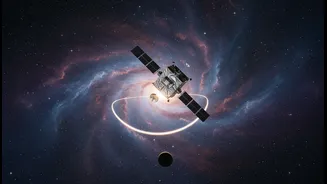
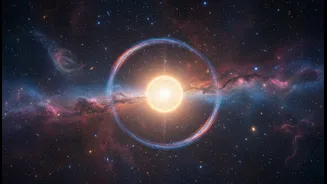
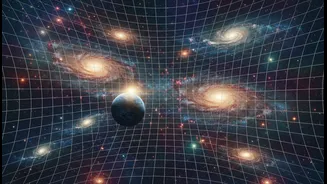
So how do you find a planet you can't see, orbiting a star 40,000 light-years away? You use a century-old prediction from Albert Einstein. His theory of general relativity tells us that massive objects warp the fabric of spacetime. Think of it like placing a heavy bowling ball on a stretched-out trampoline; the fabric dips and curves. Now, imagine rolling a marble past the bowling ball; its path will bend. The same thing happens with light. When a star and its planet pass directly in front of a more distant star, their combined gravity acts like a lens. This 'gravitational microlensing' bends and magnifies the light from the background star, causing it to temporarily appear brighter. If the foreground star has a planet, the planet's own gravity creates a second, smaller distortion—a brief, extra flicker of light that scientists can detect.
A New Trick for an Old Telescope
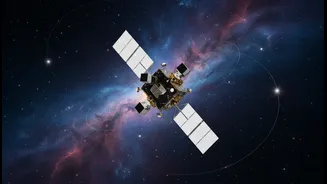
NASA's Transiting Exoplanet Survey Satellite (TESS) wasn't built for this. TESS typically finds planets using the 'transit' method, where it stares at stars and waits for a slight dip in brightness caused by a planet passing in front of it. This method works best for large planets orbiting very close to their stars. Gaia23bra b is far from its star, so it would likely never be found this way. However, scientists reviewing data from the initial Gaia alert in 2023 realised that TESS happened to be looking at the same patch of sky at the exact right time. Its high-frequency observations—taking images every couple of minutes—captured the detailed signature of the planet within the larger microlensing event, something the sparser Gaia data couldn't do on its own. It was a discovery hiding in plain sight, proving TESS could do something no one expected.
Unlocking the Unseen Universe
This discovery is more than just adding one more world to the catalogue of over 6,000 confirmed exoplanets. It's a game-changer because microlensing opens a new window into the cosmos. The transit method, which accounts for about 75% of known exoplanets, is biased towards finding 'hot Jupiters' and other planets in tight orbits. Microlensing, on the other hand, is uniquely suited to finding planets on wider orbits, similar to those in our own solar system. It can even find smaller, Earth-mass planets and 'rogue' planets that drift through space without a host star. This new success with TESS data serves as a powerful proof of concept and a preview of what's to come. Astronomers believe there are likely many more such planets hiding in existing data.