

In the vast theatre of space, few mysteries are as compelling as a disappearing planet. Astronomers thought they had found a new world, Fomalhaut b, only for it to vanish. Now, the cosmic case is closed, and the solution is spectacular.
The Ghost Planet of Fomalhaut
Twenty-five light-years
away, in the constellation Piscis Austrinus, lies the bright star Fomalhaut. In 2008, astronomers announced a landmark discovery: using the Hubble Space Telescope, they had taken the first direct image of an exoplanet, a world they named Fomalhaut b. It appeared as a distinct dot of light moving through space, a seemingly monumental confirmation of a new planet. However, from the beginning, Fomalhaut b was a puzzle. It was unusually bright in visible light but had no detectable heat signature in the infrared, which is highly uncharacteristic for a large planet. This discrepancy was the first clue that something about this distant world was not what it seemed.
Now You See It, Now You Don't
As astronomers continued to observe Fomalhaut b over the years, the mystery only deepened. Instead of being a stable, orbiting world, follow-up observations showed it was behaving strangely. The 'planet' seemed to be expanding and, most perplexingly, it was fading. Data from Hubble showed that the object was growing dimmer over time. Then, in images taken in 2014, it was gone entirely. Planets, as a rule, do not simply vanish. The disappearance sent shockwaves through the astronomical community, turning Fomalhaut b into a celestial ghost story. As one astronomer put it, Fomalhaut b 'was doing things a bona fide planet should not be doing'.
A Collision of Cosmic Proportions
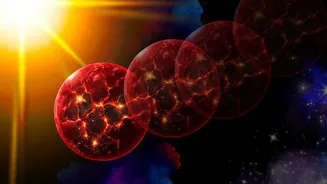
The solution to the puzzle, proposed by astronomers András Gáspár and George Rieke from the University of Arizona, was as dramatic as the disappearance itself. Their analysis of all available Hubble data suggested Fomalhaut b was never a planet to begin with. Instead, what Hubble had witnessed was the immediate aftermath of a colossal collision between two large, icy bodies. They calculated that two objects, each likely around 200 kilometres wide, had smashed into each other. What astronomers had mistaken for a planet was, in fact, an expanding cloud of extremely fine dust from this cataclysmic event. We weren't seeing a planet; we were seeing its ghost.
An Expanding Cloud of Dust
This 'massive planetesimal collision' model perfectly explained the bizarre observations. The initial impact created a dense, bright cloud of dust that was visible to Hubble. But as that cloud expanded and drifted through space, pushed by the radiation from its star, it became more and more diffuse. The dust particles, estimated to be just 1 micron in size (about 1/50th the diameter of a human hair), spread out over an enormous area. By 2014, the cloud had dispersed so much that it fell below Hubble's detection limit, effectively vanishing from sight. The theory also explained the 'planet's' odd, escaping trajectory; it wasn't bound by gravity like a planet but was being blown away like smoke.
A Blueprint for Planetary Destruction
While the discovery means one less exoplanet on the official list, it provides something arguably more valuable: a rare glimpse into the chaotic and violent processes that shape solar systems. Such collisions are thought to be a common part of planetary evolution, but they are incredibly rare to witness. Scientists estimate an event of this magnitude might happen in the Fomalhaut system only once every 200,000 years. Being at the right place at the right time allowed astronomers to see a 'blueprint of how planets destroy each other', in the words of George Rieke. The story of Fomalhaut b is a powerful reminder that the universe is a dynamic, evolving place, and even when a discovery is re_evaluated, it often leads to a deeper, more fascinating truth.