


For millennia, humanity has looked to the Sun as a symbol of permanence. But science tells us it has a finite lifespan. Now, groundbreaking research is moving away from a single prediction, using hundreds of simulations to map its distant future.
The Sun's Inevitable Decline
Our Sun
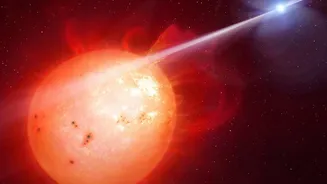
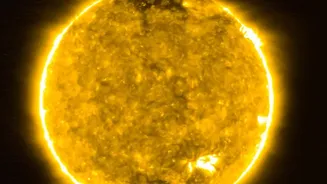
is currently a middle-aged star, about 4.6 billion years old. It generates energy by fusing hydrogen atoms into helium in its core. This process has provided the stable light and heat that allowed life to flourish on Earth. However, this fuel is not infinite. In approximately five billion years, the Sun will exhaust the hydrogen in its core, triggering the beginning of its end. Without the outward pressure from hydrogen fusion, gravity will cause the core to contract and heat up. This will, in turn, cause the Sun's outer layers to expand dramatically. The star will swell to hundreds of times its current size, its surface will cool and redden, and it will become what astronomers call a red giant.
Why One Prediction Isn't Enough
For years, models of the Sun's death were relatively straightforward, predicting a linear sequence of events. However, stellar evolution is an incredibly complex process. A star's final stages are influenced by numerous variables, including its mass, rotation, and the precise mechanics of how it sheds its outer layers. Recent research highlights that assuming a smooth, uniform mass loss for the dying Sun might be too simple. The process could be uneven, happening in thousands of separate bursts that could have chaotic effects on the planets. Due to these complexities and uncertainties, a single, deterministic prediction is scientifically fragile. To get a more accurate picture, scientists have turned to probabilistic modeling, which accepts that we can't know the exact starting conditions or processes with perfect certainty.
The Power of Many Simulations
Instead of making one forecast, modern astrophysicists run hundreds, or even thousands, of computer simulations. Each simulation starts with slightly different initial parameters for the Sun or models its mass loss in a different way. For example, a recent study ran 672 simulations to see how the outer solar system would react to different patterns of solar mass loss. By analysing the outcomes of all these scenarios, researchers can build a statistical understanding of what is most likely to happen. If a particular outcome, like the destabilisation of a planet's orbit, occurs in a high percentage of the simulations, it is considered a probable future. This method doesn't provide a single 'right' answer but offers a range of possibilities weighted by likelihood, giving us a more robust and honest scientific forecast.
A Glimpse into The End
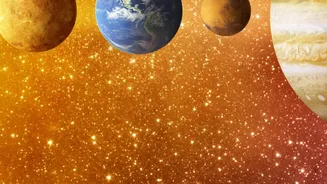
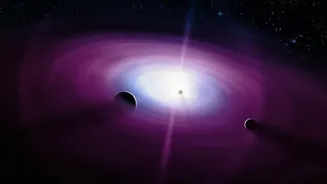
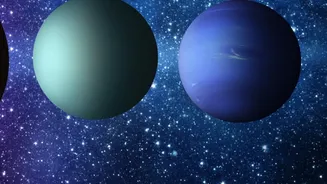
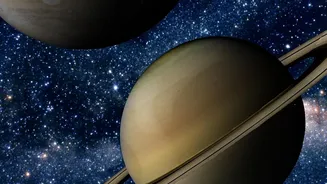
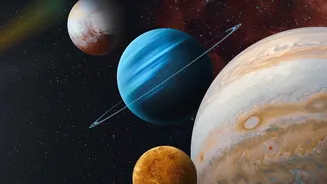
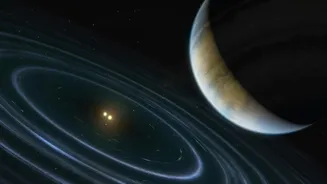
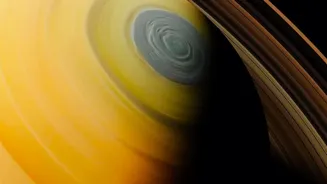
These simulations confirm the Sun's transformation into a red giant that will engulf Mercury and Venus. After this phase, which may last about a billion years, the Sun will shed its outer layers, creating a beautiful, glowing cloud of gas and dust called a planetary nebula. At the centre of this nebula will be the Sun's collapsed, super-dense core: a white dwarf. This Earth-sized remnant will no longer produce energy through fusion and will simply cool and fade over trillions of years. The new research using multiple simulations suggests a more chaotic end for the outer planets than previously thought. Instead of settling into wider, stable orbits, Jupiter, Saturn, Uranus, and Neptune could be thrown into disarray, with some planets even being ejected from the solar system entirely.
What About Earth?
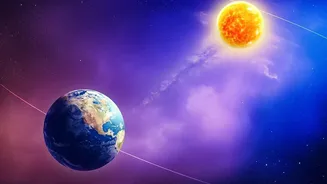
Earth's ultimate fate hangs in a delicate balance. As the Sun becomes a red giant, it will lose mass, weakening its gravitational pull and causing Earth's orbit to drift outward. Simultaneously, the Sun's expanding atmosphere will create a drag effect, pulling our planet inward. For a long time, the consensus was that Earth would be swallowed. However, more recent models suggest Earth might just barely escape being engulfed, settling into a new, wider orbit around the white dwarf. But this is no cause for celebration. Long before the Sun reaches its red giant phase, its increasing luminosity will have boiled our oceans away and scorched the surface, making our planet completely uninhabitable within about a billion years.