





Our New Eye on the Universe
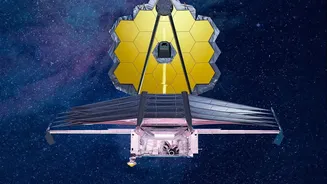
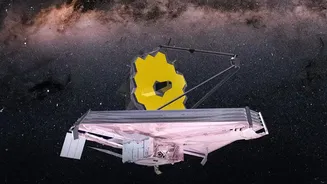
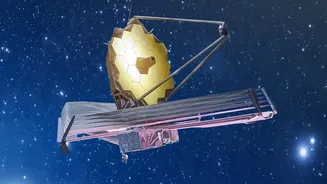
The James Webb Space Telescope is the most powerful space observatory ever built, a joint effort by NASA, the European Space Agency, and the Canadian Space Agency. Launched on Christmas Day 2021, it orbits the sun 1.5 million kilometres from Earth, using
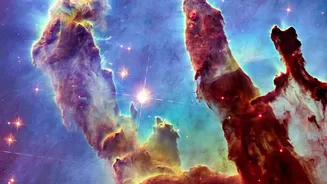
its massive golden mirror and advanced instruments to gaze into the cosmic dawn. Unlike the Hubble Space Telescope, which primarily sees the universe in visible and ultraviolet light, JWST is optimised to see in infrared. This is crucial for two reasons. Firstly, infrared light can pierce through the dense clouds of gas and dust where stars and planets are born. Secondly, because the universe is expanding, light from the most distant objects is stretched, or 'redshifted', into the infrared spectrum. This makes JWST a time machine, allowing astronomers to study the first galaxies and the formation of planetary systems with incredible clarity.
The Science of Seeing Water from Afar
So how does a telescope spot water on a planet hundreds of light-years away? The technique is called transmission spectroscopy. When an exoplanet passes in front of its host star from our point of view, a tiny fraction of the starlight filters through the planet's atmosphere. Different molecules in the atmosphere absorb specific wavelengths, or colours, of light, leaving a unique chemical fingerprint on the light that reaches the telescope. Water vapour, for example, absorbs very specific frequencies of infrared light. By capturing a spectrum—a breakdown of light by wavelength—JWST's sensitive instruments can identify the telltale signature of water molecules, even across the vast emptiness of space. It's like analysing the ingredients of a cake by only looking at the steam rising from it.
A Breakthrough in Sensitivity
While astronomers have found water on exoplanets before, this latest discovery represents a significant technological advance. The headline-making capability stems from JWST's Mid-Infrared Instrument, or MIRI. This incredibly sensitive piece of hardware can detect faint infrared signals with unprecedented precision. The 'breakthrough' isn't a single new gadget, but the sheer power of MIRI's sensors combined with sophisticated data processing. These sensors are so sensitive they have to be kept incredibly cold—around -266 degrees Celsius—to function properly. This allows them to pick out the faint signal of a planet's atmosphere from the overwhelming glare of its parent star. Previously, many attempts to study the atmospheres of smaller planets resulted in flat, featureless spectra, with haze or clouds obscuring the view. The new level of detail from JWST's instruments allows scientists to cut through this noise and resolve the chemical composition of atmospheres that were previously inaccessible.
More Than Just a Drop in the Cosmos
The detection of water vapour is always an exciting milestone in exoplanet science. Here on Earth, water is the essential ingredient for life as we know it. Finding it elsewhere, especially in the terrestrial region of a star system where rocky planets might form, is a critical step in assessing the potential for habitability. The recent discovery was made in the inner disk of a young star system called PDS 70, a region where planets similar to Earth are thought to form. Finding water here suggests that the raw materials for life could be common throughout the galaxy, delivered to new worlds as they come into being. This doesn't mean life has been found, but it confirms that one of the most important prerequisites can be present in the right places at the right time.