
The Ultimate Lifeboat: What is the Crew Escape System?
Think of the Crew Escape System (CES) as the ultimate ejection seat, not for a pilot, but for the entire space capsule carrying the astronauts. It is an emergency abort mechanism designed to rapidly pull the crew module away from its rocket in the event
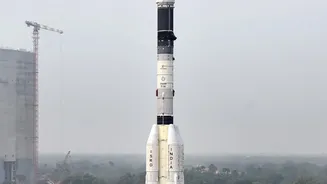
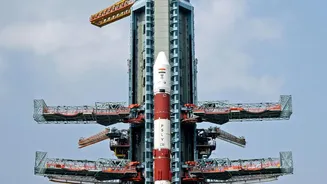
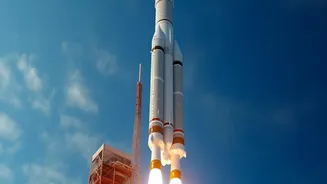
of a catastrophic failure on the launch pad or during the ascent into the atmosphere. This system is ISRO's answer to the immense risks involved in space travel, ensuring that the crew can be whisked to safety within milliseconds of a detected anomaly. The CES is a tower-like structure fixed to the very top of the human-rated LVM3 rocket, containing a set of powerful, quick-acting solid-fuel motors. Unlike the main rocket engines, these are designed for one purpose only: to ignite in an instant and produce immense thrust to outrun a potential explosion.
Scenario 1: Trouble on the Launch Pad
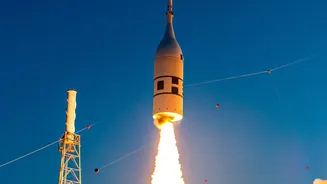
An emergency can occur even before the rocket leaves the ground. If the onboard computers detect a critical problem during the final countdown or at the moment of ignition, the Pad Abort Test has proven what happens next. In a real-life scenario, the CES would fire its motors to pull the crew module vertically and laterally away from the launch pad. In a 2018 test, ISRO successfully demonstrated this scenario, where the system lifted a test capsule to an altitude of nearly 2.7 km before it parachuted safely into the Bay of Bengal. This rapid extraction ensures the crew is a safe distance away from any potential explosion on the ground, providing the first layer of safety before the journey to space even begins.
Scenario 2: Mid-Air Abort at Supersonic Speeds
The most aerodynamically stressful part of a launch is the transonic phase, where the rocket is travelling around the speed of sound (Mach 1.2) and experiences maximum dynamic pressure. An abort at this stage is extremely complex. ISRO successfully demonstrated its capability to handle this scenario with the Test Vehicle Abort Mission-1 (TV-D1) in October 2023. In this test, a vehicle carrying the crew module and escape system was launched to an altitude of about 12 km. An in-flight abort was deliberately triggered, and the CES motors fired, powerfully separating the crew module from the booster rocket. The system is designed with different sets of motors, including high-altitude escape motors and pitch motors, which work together to steer the capsule on a safe trajectory away from the failing launch vehicle.
A Safe Return: Parachutes and Splashdown
Successfully escaping the rocket is only half the battle; the crew module must then return to Earth safely. After the escape motors burn out and the capsule has reached a safe distance, the CES tower is jettisoned. The crew module then begins its descent. To manage the high speeds, a sequence of parachutes is deployed. First, smaller drogue parachutes deploy to stabilize the capsule and slow it down. Following this, a set of three large main parachutes unfurls to reduce the speed for a gentle splashdown in the ocean. The system is redundant, meaning even one main parachute is sufficient for a safe landing. Once in the water, a Crew Module Uprighting System (CMUS) uses gas-powered flotation bags to ensure the capsule stays upright, allowing recovery teams from the Indian Navy to retrieve the astronauts.