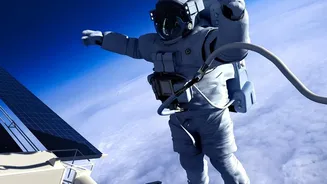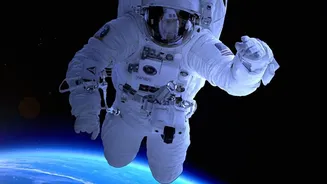






We’ve all seen the videos: astronauts gracefully floating inside a space station. It looks like gravity just switched off. But if gravity is still there—and it is—why do they feel, and look, completely weightless? The answer is a neat trick of physics.
The Feeling You Call 'Weight' Is a Lie
Let's start with a counterintuitive idea: you can't actually feel gravity. Gravity is a non-contact force that pulls on every single atom in your body equally. What you perceive as your 'weight' is not gravity's pull, but the force of the ground, your chair, or your bed pushing back up at you. Physicists call this the 'normal force'. Think about standing on a bathroom scale. The number you see isn't directly measuring gravity; it's measuring how much upward force it needs to exert to stop you from falling through it. This sensation of being supported, of your body being slightly compressed against a surface, is what our brains interpret as weight. Take away that upward push, and the sensation of weight vanishes, even if the force of gravity doesn't.
The Classic Elevator Analogy
To understand how this works, imagine you're in an elevator standing on that same bathroom scale. When the elevator is still, the scale shows your normal weight. Now, the elevator accelerates upward. For a moment, you feel heavier, and the scale's number jumps up. That's because the floor has to push harder on you—not just to support your weight, but also to accelerate you upward. Your 'apparent weight' has increased. Now, imagine the opposite: the elevator accelerates downward. You feel a lurch in your stomach and a sensation of lightness. The scale briefly shows a lower number. That’s because the floor is falling away from you slightly, so it doesn't need to push up as hard. Your apparent weight has decreased. The force of gravity on your body hasn't changed at all, but the feeling of your weight has.
Free-Fall: When the Floor Gives Way Entirely
Now for the dramatic part: what if the elevator cable snaps? The elevator, you, and the scale inside all start falling toward the ground at the exact same rate—the acceleration of gravity. Because the scale is falling at the same speed you are, your feet are no longer pressing down on it. The scale reads zero. You are experiencing free-fall. You have an apparent weight of zero, and you feel completely weightless. This is the key: weightlessness is not the absence of gravity; it's the absence of a force pushing back against you. You are still very much under gravity's influence—that's why you're falling—but because everything around you is falling too, there are no contact forces to create the sensation of weight.
From Orbiting Astronauts to Roller Coasters
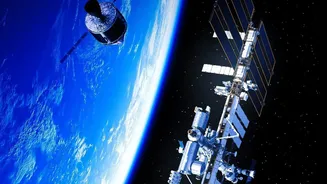
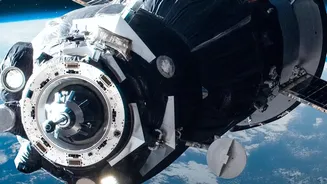
This is precisely what happens to astronauts in orbit. The International Space Station (ISS) is about 250 miles up, where Earth's gravity is still about 90% as strong as it is on the surface. So why do they float? Because the ISS and everything in it are in a constant state of free-fall. They are continuously falling toward Earth, but they are also moving sideways at over 17,000 miles per hour. This incredible speed means that as they fall, the Earth's surface curves away beneath them at the same rate. They are literally falling 'around' the planet, never getting any closer. You can experience the same sensation for a few brief, stomach-lurching seconds at the top of a big roller coaster hill. As the car goes over the crest, it's momentarily in free-fall, and you lift out of your seat, feeling perfectly weightless.