







An Icon in a Slow-Motion Fall
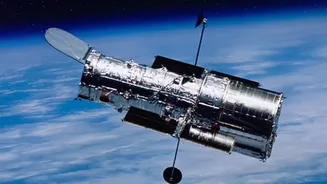
For more than three decades, the Hubble Space Telescope has been humanity's eye on the cosmos, delivering breathtaking images and groundbreaking science that have reshaped our understanding of the universe. Launched in 1990, it orbits about 547 kilometers
above Earth, free from the distorting effects of the atmosphere. But its time is running out. The very thin atmosphere at that altitude creates a tiny amount of drag, which has been causing Hubble's orbit to slowly decay. Without a propulsion system of its own to counteract this pull, the telescope is predicted to re-enter Earth's atmosphere sometime between 2033 and 2034. This orbital decay is a natural process, but one that threatens to bring a fiery end to a priceless scientific instrument.
The Commercial Rescue Plan
With the Space Shuttle program retired, NASA no longer has its own vehicle to service the telescope as it did in the past. So, in a significant policy shift, the agency has issued a formal Request for Information (RFI), essentially asking the private space industry for a rescue plan. The RFI invites companies to submit ideas for one of three possibilities: capturing Hubble and boosting it to a higher, more stable orbit; servicing it to enhance its performance; or guiding it to a safe, controlled splashdown in the ocean. The primary goal is a 're-boost' to an altitude of at least 600 kilometers, which could extend Hubble's life by another 25 years. Any mission would need to happen by 2032 and, crucially, must not harm the telescope.
Who Could Answer the Call?
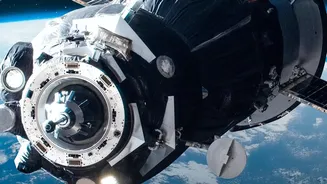
This isn't just a theoretical exercise; it's a real business opportunity for the booming commercial space sector. The most talked-about contender is SpaceX. In 2022, the company, in partnership with the Polaris Program led by billionaire Jared Isaacman, conducted a study with NASA on the feasibility of using a Dragon spacecraft to re-boost Hubble. While that specific plan was not pursued at the time, the new RFI opens the door for a revised proposal from them or other players. The RFI is open to any company with the capability, which could include established aerospace firms and newer startups specializing in in-orbit servicing. The responding company would be responsible for providing the rocket, the spacecraft, mission operations, and even the crew, if the mission requires astronauts.
A Mission Fraught With Challenge
Saving Hubble would be a complex and risky endeavor. The telescope was designed to be serviced by astronauts on the Space Shuttle, not by the robotic or commercial vehicles of today. Any approaching spacecraft would need to perform a delicate rendezvous and capture maneuver without damaging Hubble's sensitive instruments or solar arrays. A robotic mission would rely on advanced automation, while a crewed mission would require new procedures and possibly even spacewalks from a commercial vehicle like a SpaceX Dragon, something never done before for this purpose. This is not a formal contract; NASA has allocated no funding yet. It's a market study to see what is possible, what it might cost, and which companies are up to the challenge before the agency commits taxpayer money.
More Than a Telescope
The effort to save Hubble is about more than just one mission. It represents a new model for space exploration, where public–private partnerships sustain critical infrastructure in orbit. If a commercial company can successfully and affordably extend the life of Hubble, it could create a new market for servicing other valuable satellites, both government and private. Hubble's scientific work is also far from over. Its unique ability to observe in visible and ultraviolet light complements the infrared focus of the newer James Webb Space Telescope. Keeping it operational would preserve a vital tool for astronomers as they wait for the next generation of great observatories, like the Habitable Worlds Observatory planned for the 2040s. This call to the private sector is a test case for a more sustainable and collaborative future in space.