





Seeing the Invisible
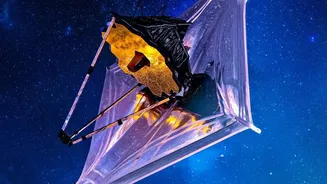
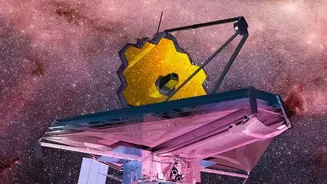
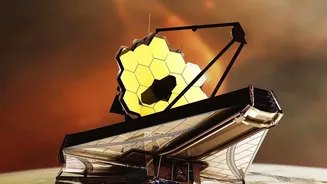
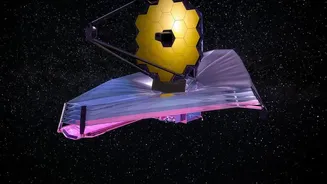
To understand why the James Webb Space Telescope is so revolutionary, you have to understand its superpower: infrared light. Many of the universe's most fascinating events, including the birth of stars, happen inside dense clouds of cosmic gas and dust.
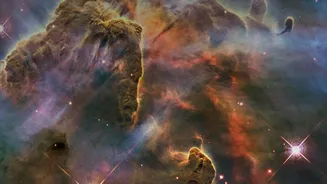
These clouds are so thick that they block visible light, the kind our eyes and telescopes like Hubble primarily see, leaving astronomers in the dark. But Webb is designed to detect infrared light, which has longer wavelengths that can penetrate these dusty cocoons. This allows scientists to peer inside and witness processes that were previously hidden, giving us an unprecedented look at stars in their earliest stages of development.
A Portrait of a Prolific Nursery
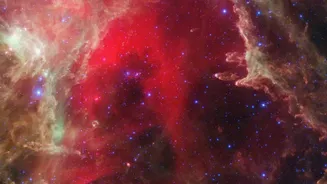
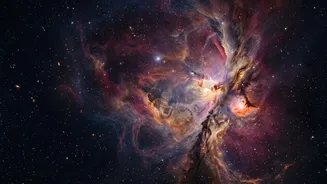
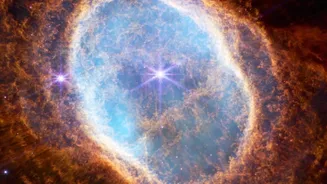
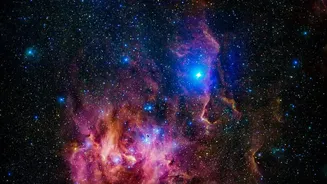
One of the most spectacular recent targets for Webb is Sagittarius B2, the most active and largest star-forming cloud in our entire Milky Way galaxy. Located just a few hundred light-years from the supermassive black hole at the galactic center, this region is an engine of creation. Though it contains only about ten percent of the galactic center's gas, it's responsible for producing an astonishing fifty percent of its new stars. Webb’s images of Sagittarius B2 reveal this crowded stellar nursery in unmatched detail. The telescope's Near-Infrared Camera (NIRCam) cuts through the obscurity to show brilliant newborn stars, while its Mid-Infrared Instrument (MIRI) highlights the warm, glowing dust and gas that fuel their formation.
Jets, Disks, and Infant Stars
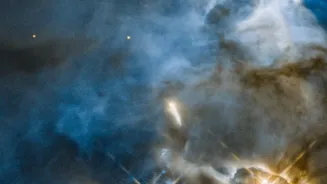
So what are we actually seeing in these breathtaking new images? We're witnessing the chaotic and beautiful process of star birth. At the heart of these nurseries are protostars—infant stars that are still gathering mass from the clouds around them. In images of objects like Herbig-Haro 46/47, Webb has captured a pair of young stars deeply buried in a disk of gas and dust that feeds their growth. As these young stars consume material, they also blast out powerful jets of gas and matter in opposite directions. These jets, sometimes appearing as brilliant pink and red spikes or delicate blue threads in Webb's images, slam into the surrounding molecular clouds, causing them to light up and creating spectacular cosmic light shows. It is within these swirling disks of leftover material that planets will eventually begin to form.
Rewriting Our Cosmic Story
These new views are more than just pretty pictures; they are providing invaluable data that is reshaping our understanding of star formation. By studying stellar nurseries, scientists can learn more about how stars of different sizes and ages form, which in turn informs our knowledge of how planetary systems, including our own, come into being. For instance, some of the darkest patches in the images of Sagittarius B2 are not empty voids, but areas so dense with gas and dust that even Webb's infrared vision cannot see through them. These are the sites of future stars, just beginning their gravitational collapse. By analyzing the light from these regions, astronomers can identify the presence of ices and complex organic molecules, the foundational ingredients for life-bearing planets. Every new image helps piece together the grand story of our cosmic origins.