


A Decagon in the Clouds
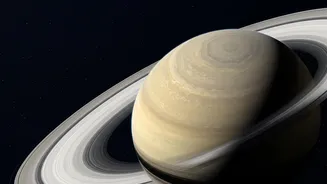
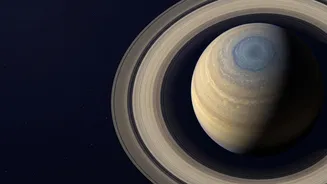
Recent observations from the Hubble Space Telescope have confirmed the existence of a massive, 10-sided atmospheric wave, or decagon, encircling Saturn's south pole. This colossal structure, roughly 104,000 miles across, is a new development, having first
been hinted at in images from 2023. Unlike its northern counterpart, this southern polygon appears to be evolving, giving scientists a rare chance to watch a planetary-scale weather system develop in real time. Researchers pieced together observations from Hubble's Outer Planet Atmospheres Legacy (OPAL) program, which annually photographs the outer planets, to track the feature's emergence from a faint ripple into a defined, 10-sided shape. Its appearance was a genuine surprise, as NASA's Cassini spacecraft, which orbited Saturn from 2004 to 2017, saw no such persistent geometric shape at the south pole.
A Tale of Two Polygons
Saturn's most famous atmospheric feature is the hexagon at its north pole, a remarkably stable six-sided jet stream first spotted by the Voyager probes in the 1980s. For over 40 years, it was considered a one-of-a-kind oddity in the solar system. The discovery of a southern decagon changes that narrative, suggesting that forming geometric shapes may be a fundamental behavior of Saturn's atmosphere under the right conditions. But the two are not identical twins. The hexagon is a long-lived, stable feature, while the decagon is a newcomer that appears to be strengthening. Furthermore, the number of sides in such a wave is directly related to the characteristics of the jet stream it inhabits. A 10-sided pattern implies a southern jet configured differently from its northern sibling, providing a rich new puzzle for planetary scientists to solve.
The Science of Celestial Shapes
These giant polygons are not just patterns on the cloud tops; they are deep, vertically extended atmospheric structures. Observations at different wavelengths show the decagon's position shifting slightly, which indicates it extends through multiple layers of the atmosphere. The fundamental physics behind these shapes is thought to involve instabilities in powerful, rotating jet streams that encircle the poles. While Earth has jet streams, they are disrupted by landmasses and receive far more solar energy, preventing such neat geometric patterns from forming. On a gas giant like Saturn, the conditions are perfect for these waves to lock into stable, polygonal shapes. Scientists have even replicated similar geometric vortices in laboratory experiments with spinning fluids, hinting that this is a universal principle of fluid dynamics at play.
Why Did It Appear Now?
One of the biggest mysteries is why the decagon formed so recently. Part of the answer lies in Saturn's long, 29-year orbit and axial tilt. For years, the south pole was tilted away from Earth's view, only re-emerging into the light around 2023. When Cassini was studying the planet, it was summer in the southern hemisphere, and the pole was fully illuminated, but no decagon was present. Now, as the southern hemisphere moves through spring towards its own summer, the increase in solar radiation might be driving changes in the atmosphere that allowed the pattern to form. Researchers also noted the emergence of a nearby vortex that darkened just before the decagon appeared, speculating it may have provided the initial disturbance needed to kickstart the wave's formation. The timing provides an unprecedented opportunity to study the birth of one of these giant weather systems.
What This Discovery Means
The southern decagon proves that Saturn's northern hexagon is not a fluke. It confirms that gas giants can generate these incredible, regular patterns at both poles, a major step forward in understanding planetary atmospheres. Studying how the decagon evolves will provide invaluable data for atmospheric models that are also used to understand weather and climate on Earth, albeit on a much different scale. For now, scientists are eagerly awaiting further observations from both Hubble and the James Webb Space Telescope. Watching this new, 10-sided mystery unfold will help unravel the complex forces that shape the atmospheres of the giant planets in our solar system and beyond.