







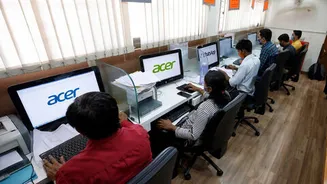
With India's office-based workforce projected to hit 48 million by 2030, a powerful new variable is entering the equation: artificial intelligence. But instead of killing the office, AI is poised to radically reinvent its purpose.
More Workers, Different Work
Contrary to fears of
mass job displacement, India's office-using workforce is on a significant growth trajectory. Projections from real estate consultancy Cushman & Wakefield indicate a rise from about 38 million in 2025 to 48 million by 2030. This expansion, adding nearly 1.8 million workers annually, is fuelled by the continued growth of office-based services and, crucially, Global Capability Centres (GCCs). These GCCs are increasingly moving beyond routine tasks to focus on higher-value activities like R&D, product engineering, and analytics. This means that while AI will automate repetitive functions, it will also create demand for new roles and skills, driving overall headcount growth rather than shrinking it.
The Shift from Quantity to Quality
The central impact of AI on office space is not about reducing the total square footage, but about fundamentally changing what companies need from that space. The consensus among real estate experts is that the 'flight to quality' trend is accelerating. As AI handles mundane tasks, the physical office's role is shifting from a place for individual, heads-down work to a hub for collaboration, innovation, and fostering corporate culture. This translates into a demand for high-quality, adaptable, and amenity-rich environments that can attract and retain top talent. Companies are prioritising buildings with advanced tech infrastructure, better connectivity, and spaces designed to support dynamic, team-based projects.
Embracing the 'Core and Flex' Model
AI is making it harder for business leaders to forecast their long-term headcount and space needs with certainty. A 2026 survey found that 60% of executives feel AI has complicated these predictions. In response, companies are moving away from long, rigid leases toward more agile real estate strategies. The 'core and flex' model is gaining significant traction, where a company maintains a central, high-quality headquarters (the core) while utilising flexible or co-working spaces to handle fluctuations in team size and project needs (the flex). According to a CBRE survey, about 67% of occupiers in India plan to have flex space in their portfolio within two years, acknowledging the need for greater operational agility.
The Rise of Smart, AI-Enabled Buildings
AI's influence extends beyond workforce strategy to the very buildings themselves. Adoption of AI in commercial real estate management has surged, with one JLL survey noting that 91% of Indian companies were piloting or planning AI_enabled solutions in 2025, up from under 5% in 2023. This technology is being used for everything from optimising energy consumption and predictive maintenance to enhancing security and personalising the employee experience through smart systems. For occupiers, a building's tech capabilities are becoming a critical factor, as they directly support the advanced functions and data_driven operations that define the modern, AI_augmented workplace.
A Resilient Market with Evolving Demands
Despite the disruptive potential of AI, the Indian office market remains remarkably resilient. Leasing activity has been strong, and India's total office stock surpassed the 1 billion square foot mark in mid_2026. However, this growth comes with a caveat. New supply is expected to keep vacancy rates slightly elevated, peaking at around 16.2% in 2029 before normalising. This dynamic creates a tenant_favourable market where the pressure is on landlords to provide the high_quality, tech_ready, and well_located spaces that companies now demand. While a majority of firms report that AI has not yet had a material impact on leasing decisions, it is ranked as the top factor expected to influence their strategies in the coming $12$-$24$ months.