



A Personal Spacecraft
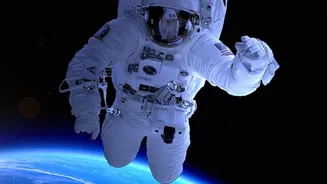
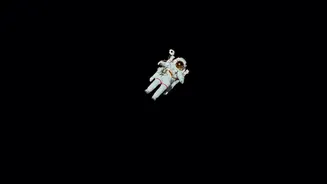
It’s a mistake to think of a spacesuit as mere clothing. It’s better understood as a miniature, human-shaped spacecraft. The formal name for NASA’s suit, the Extravehicular Mobility Unit (EMU), says it all: it’s a system that allows movement outside a vehicle.
This 'soft' spacecraft is tasked with providing everything an astronaut needs to stay alive in an environment that offers nothing but threats. It must supply air, maintain pressure, manage extreme temperatures, and protect against radiation and high-velocity debris. Every component, from the helmet down to the boots, is a marvel of engineering designed for a single purpose: to keep the fragile human body inside it alive and functioning for up to eight hours.
Fighting the Void
The most immediate threat in space is the vacuum. Here on Earth, the atmosphere pushes on our bodies with a constant pressure. In space, that pressure is gone. Without a pressurized suit, an astronaut would lose consciousness in about 15 seconds. The gases in their blood would come out of solution and their body fluids would begin to vaporize in a process called ebullism. To counter this, the spacesuit contains an airtight, rubbery layer called a pressure bladder. This layer is inflated with pure oxygen to a pressure of about 4.3 pounds per square inch (psi). While much lower than Earth's 14.7 psi, it’s enough to keep the body's fluids liquid and provide breathable air, while a restraint layer prevents the suit from ballooning into a rigid, immovable shape.
Surviving Extreme Temperatures
Space is a world of thermal extremes. An object in direct sunlight can bake at temperatures up to 121°C (250°F), while in shadow it can plunge to a frigid -157°C (-250°F). A spacesuit must protect the astronaut from both simultaneously. The suit's outer layer is typically white to reflect as much solar heat as possible. Beneath this is the Thermal Micrometeoroid Garment, a set of up to 14 layers. This includes multiple layers of aluminized Mylar, which work like a high-tech thermos flask, separated by spacer fabric. But insulation isn't enough. Astronauts generate significant body heat while working. To prevent overheating, they wear a Liquid Cooling and Ventilation Garment underneath everything. This snug, full-body garment has about 300 feet of tubing woven into it, circulating cool water to draw heat away from the body.
A Shield Against Space Dust
The vacuum of space is not truly empty. It's filled with micrometeoroids and tiny pieces of orbital debris, some travelling at over 27,000 kilometres per hour. A collision with even a paint fleck at these speeds could be catastrophic, potentially puncturing the suit and causing a fatal depressurization. The outer layers of the spacesuit are designed to be a shield. The Thermal Micrometeoroid Garment's tough outer shell, often made of a blend of materials including Gore-Tex, Kevlar, and fire-resistant Nomex, is the first line of defense. These layers are designed to break up and vaporize incoming particles before they can reach the critical pressure bladder underneath, providing a robust defense against the constant threat of high-speed impacts.
The Backpack That Gives Life
All of these systems are supported by the suit's backpack, officially called the Portable Life Support System (PLSS). This unit contains the oxygen tanks for breathing and suit pressurization, and batteries to power the suit's electronics, fans, and pumps. It also houses the system for removing the carbon dioxide that the astronaut exhales. The PLSS manages the water circulation for the cooling garment, taking in the warmed water and using a process called sublimation to vent heat into space. It’s the heart and lungs of the entire suit, a self-contained life-support module that makes survival outside the spacecraft possible.