





Meet the Cigar Galaxy
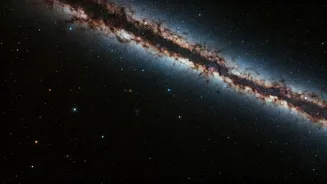
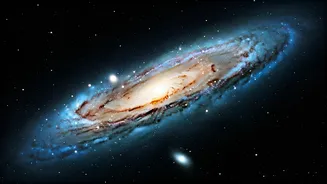
Located 12 million light-years away, Messier 82, or the Cigar Galaxy, isn't just any spiral galaxy. It's what astronomers call a 'starburst' galaxy. This means it is producing new stars at a furious pace—about ten times faster than our entire Milky Way.
This intense activity is believed to be the result of a gravitational encounter with its larger neighbor, galaxy M81, millions of years ago. This cosmic tug-of-war sent vast amounts of gas pouring into the Cigar Galaxy's core, providing the raw fuel for its spectacular, but temporary, frenzy of star birth. This makes M82 a perfect natural laboratory for studying a pivotal and extreme phase in a galaxy's life.
Webb's Infrared Superpowers
For decades, much of the action in the Cigar Galaxy's core remained hidden from view. Telescopes like Hubble, which primarily see visible light, were blocked by immense clouds of cosmic dust. This is where the James Webb Space Telescope (JWST) changes the game. Webb is designed to see the universe in infrared light, a wavelength that can penetrate these dense dust shrouds. By peering through the cosmic smog, Webb provides an unprecedentedly clear view of the processes happening within. It's like having a pair of X-ray glasses that can see straight to the heart of the galactic engine room, revealing secrets that were previously impossible to observe.
Riding a Galactic Superwind
One of the most dramatic features revealed by Webb is the galactic 'superwind'—a colossal outflow of material being blasted out from the galaxy's center. This isn't a gentle breeze; it's a violent expulsion of gas and elements, powered by the combined energy of thousands of brilliant young stars and the explosive force of countless supernovae. Webb's new images show this wind in stunning detail, capturing fiery red filaments of gas extending thousands of light-years above and below the galaxy's disk. This outflow is not just destructive; it's also how galaxies enrich the cosmos, seeding the space between galaxies with heavy elements forged in the hearts of stars.
Following Sooty Clues
To map this complex superwind, astronomers are using an unlikely tracer: sooty chemical molecules called Polycyclic Aromatic Hydrocarbons (PAHs). These are very small dust grains, essentially cosmic soot, that Webb can detect with remarkable clarity. In the images, these PAHs glow in the reddish filaments of the galactic wind. By tracking this PAH emission, scientists can trace the structure of the wind from its origin in the core out into intergalactic space. This helps them understand how the wind is shaped and how it interacts with the surrounding galactic environment, a crucial piece of the puzzle in understanding galaxy evolution.
A Census of Millions of Stars
Beyond the grand structures, Webb’s incredible resolution has achieved another first. By combining its data with archival images from the Hubble Space Telescope, astronomers have been able to identify approximately 16.5 million individual stars within the galaxy. Before Webb, this dense, dusty region was just a blur. Now, scientists can begin to take a census of the stellar populations, helping them build a more complete history of the galaxy's formation and its explosive star-making phase. Each of these pinpoint stars is a data point that helps unravel the story of how this 'beautiful mess' of a galaxy came to be.